
Preparing Your Nonprofit for Audit Success
A Nonprofit Guide to GAAP Compliance and Year-Round Preparation
Passing an independent nonprofit audit requires consistent adherence to Generally Accepted Accounting Principles (GAAP) and the maintenance of strong, documented internal controls, which should be integrated into daily operations well before an audit is required. For many nonprofits, the prospect of an audit—the biggest financial challenge they may face—is daunting, but it doesn’t have to be a nightmare. The key to success is to stop viewing the audit as a one-time emergency and instead treat it as the natural culmination of a year-round commitment to accurate bookkeeping, consistent reporting, and effective systems. Starting this preparation now, regardless of current audit requirements, will save the organization significant time and tens of thousands of dollars in expenses later.
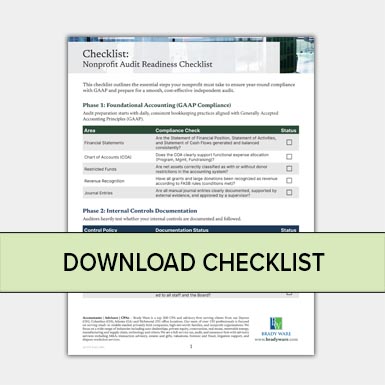
Key Takeaways
What are the two most important things a nonprofit needs to pass an audit?
The two most important things are consistent compliance with Generally Accepted Accounting Principles and maintaining strong, documented internal controls.
Which financial documents should be ready for a nonprofit audit?
You must have all monthly bank statements and reconciliations, signed Board minutes, and copies of major grant agreements ready for the auditors.
When is the best time for a nonprofit to start preparing for an audit?
The best time to prepare for an audit is every single day through consistent bookkeeping and compliance practices.
Why Audits Are the Ultimate Challenge
The word “audit” strikes fear into the hearts of many executives, and for nonprofit leaders, this feeling is often amplified. An independent audit is typically the most rigorous accounting challenge a nonprofit will face. It is an intensive, external review of an organization’s financial statements, internal controls, and compliance with rules and regulations. If a nonprofit has struggled with basic bookkeeping, inconsistent reporting, grant accounting complexities, or weak internal controls—the previous challenges we’ve discussed—the audit process forces an expensive and time-consuming reckoning. Waiting until an audit is required to start preparing can lead to months of frantic, costly work to reconcile and unravel poorly kept accounts.
The GAAP Mandate
To successfully pass an independent nonprofit audit, your organization must demonstrate that its financial statements are presented fairly in accordance with Generally Accepted Accounting Principles (GAAP). GAAP is not a suggestion; it is a comprehensive set of accounting standards that all public and most non-public entities in the U.S. must follow. For nonprofits, GAAP includes specific standards for:
- Financial Statements: Ensuring the Statement of Financial Position, Statement of Activities, and Statement of Cash Flows are accurate and consistently presented.
- Net Asset Classification: Properly distinguishing between net assets with donor restrictions (restricted funds) and net assets without donor restrictions (unrestricted funds).
- Functional Expense Allocation: Accurately allocating expenses (including payroll) to Program Services, Management & General, and Fundraising functions.
- Internal Controls: Documenting and maintaining effective policies to safeguard assets and prevent material misstatements.
In essence, an audit is a test of whether your organization’s entire financial ecosystem—from the initial receipt of a donation to the final presentation of the annual report—operates according to established professional standards.
“The best time to prepare for an audit is every single day. Consistent compliance saves money and time when the auditors arrive.”
Do You Need an Audit? The Requirements
Not every nonprofit is required to undergo a full independent audit, but the requirements can be complex and are often determined by a combination of factors:
Size
Many states or funding sources mandate an audit (or a less formal review) once an organization’s annual revenue or total expenditures reach a certain threshold, often starting around $250,000 to $500,000.
Location
Certain states, such as New York and California, have strict laws requiring audits or independent reviews based on the amount of public support received.
Funding
Large foundations and government agencies frequently require grantees to submit an audit as a condition of receiving and maintaining funding, especially if the funds exceed the $1,000,000 threshold for a Single Audit (formerly the A-133 audit) requirement.
Even if your nonprofit doesn’t meet a statutory requirement today, you will need an audit someday if you intend to significantly grow your mission. Pursuing major government grants or institutional foundation funding will inevitably lead to an audit requirement.
The Time to Prepare is Now
The single best time to start preparing for your first independent audit is right now, regardless of your organization’s current size. Why? Because the longer you put off implementing GAAP-compliant systems and robust internal controls, the more costly and time-consuming it will be for a CPA to “correct” your books later. When an external auditor has to spend dozens of extra hours reconciling accounts, researching old transactions, and reconstructing inadequate documentation, those costs—easily tens of thousands of dollars—fall directly on the nonprofit.
Preparing today means:
- Implementing Strong Internal Controls: Documenting policies for cash handling, check signing, and expense approval, and ensuring separation of duties is maintained.
- Utilizing Nonprofit-Specific Software: Using accounting software that easily facilitates fund accounting and functional expense allocation.
- Maintaining Consistent Documentation: Filing all receipts, invoices, and bank statements digitally and consistently, creating a clear audit trail.
By integrating these practices into your daily operations, you transform the audit from a painful, expensive crisis into a smooth, professional validation of your financial health, allowing your team to focus on what truly matters: advancing your mission.
Brady Ware Nonprofit Advisors want to help you fulfill your mission with financial health and compliance services and a network of nonprofit consultants who specialize in strategic decision-making.
Questions?
Chelsea’s background in audit and assurance enables her to provide specialized accounting services to nonprofit organizations.