
Preparing for a Smooth EBP Audit: DOWNLOAD
Prepare for a 401(k) Audit by Streamlining Documentation and Minimizing Audit Fatigue
How can companies prepare for a smooth employee benefit plan audit? The most effective way to ensure a seamless audit process is to gather all foundational plan documents, current-year trust statements, and updated plan amendments before the CPA firm begins fieldwork. By centralizing your ERISA Section 103(a)(3)(C) audit documentation early, you allow your auditors to focus on testing rather than administrative chasing, which significantly reduces the internal burden on your HR and finance teams. Leading with an organized “audit package” that includes your latest Form 5500 draft and service provider contracts sets a professional tone and establishes a clear timeline for a successful filing.
Key Takeaways
What documents should a company have ready before a 401k audit begins?
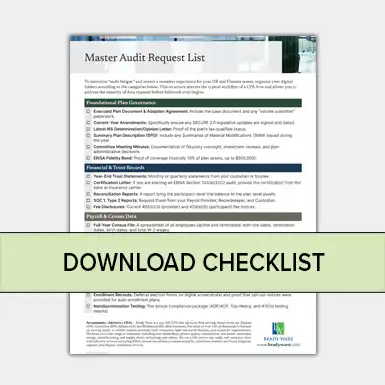
Plan sponsors should gather foundational documents like the executed plan agreement, updated SECURE 2.0 amendments, current-year trust statements, and the SOC 1 reports from their payroll and recordkeeping service providers.
How can a business reduce the internal workload during a retirement plan audit?
You can minimize “audit fatigue” by centralizing all requested documentation in a digital repository before the CPA arrives and assigning a single point of contact to manage all data requests.
What is the role of a SOC 1 report in an employee benefit plan audit?
A SOC 1 report provides independent assurance that your service providers have effective internal controls in place to ensure the accuracy and security of your plan’s financial data.
Organizing Your Foundational Documentation
An audit is only as painful as the documentation is messy, and the “mess” usually starts with missing paperwork. Before your auditors arrive, confirm that you have an executed copy of the original plan document along with every subsequent amendment. In 2026, auditors are specifically looking for SECURE 2.0 plan amendments to ensure your plan is operationally compliant with recent legislative changes. Beyond the legal documents, you must gather your summary plan descriptions (SPD) and any summaries of material modifications (SMM) distributed to employees during the year. Having these items organized in a secure digital folder prevents the common “audit fatigue” that sets in when team members have to dig through old files or contact former service providers for historical data in the middle of a deadline.
Leveraging SOC 1 Reports and Service Provider Data
Most of the heavy lifting for a modern audit actually happens between your CPA firm and your recordkeeper, but as a plan sponsor, you are the bridge. One of the most critical items on your employee benefit plan audit checklist is the SOC 1, Type 2 report from your third-party administrator (TPA) or custodian. These reports provide the auditor with independent assurance that your service provider has robust internal controls over financial reporting. Additionally, you should request “audit packages” from your recordkeeper, which typically include year-end trust statements, participant trial balances, and a reconciliation of plan assets. Proactively providing your auditor with direct, read-only access to your recordkeeping portal can eliminate dozens of manual data requests and keep the audit moving forward without constant interruptions to your daily operations.
“An audit is only as painful as your documentation is disorganized; the secret to a stress-free filing season lies in gathering your trust statements and SOC reports before the first data request even hits your inbox.”
Strengthening Internal Controls and Payroll Data
The core of any benefit plan audit is testing participant data, which means your payroll records must be pristine. Auditors will select a sample of employees and verify their eligibility, deferral percentages, and the definition of compensation used for contributions. To ensure a smooth review, prepare a comprehensive census file that includes all eligible employees—not just those currently participating—along with their hire dates, termination dates, and total W-2 wages. Documenting your 401(k) internal control procedures for enrolling new hires and processing distributions is also vital. When you can demonstrate a clear, repeatable process for how data flows from your payroll system to the plan trust, auditors can gain the necessary confidence in your plan’s integrity much faster, leading to a more efficient and cost-effective engagement.
Finalizing the Audit and Reducing Fatigue
The final stage of the audit involves reconciling the audited financial statements with your Form 5500. To minimize the time your internal team spends answering follow-up questions, assign a single point of contact to manage all auditor inquiries. This “gatekeeper” approach ensures that information is not duplicated and that the CPA firm receives consistent answers. By checking off these high-priority items—updated amendments, SOC reports, and clean census data—well in advance of your filing deadline, you transform the audit from a stressful annual hurdle into a routine check-up. Taking a proactive stance on reducing employee benefit plan audit risk not only protects your company from Department of Labor scrutiny but also ensures that your fiduciary responsibilities are met with the highest level of professional care.
Achieving Audit Readiness and Peace of Mind
Ultimately, a successful audit is built on the foundation of organization and proactive communication. By treating your employee benefit plan audit checklist as a year-round management tool rather than a seasonal scramble, you ensure that your plan remains in good standing with both the IRS and the Department of Labor. In 2026, the focus has shifted toward digital transparency; having your SOC 1 reports and SECURE 2.0 amendments ready for immediate digital delivery is the best way to avoid the delays that lead to “audit fatigue.” Remember that the goal of a thorough audit is not just to file a return, but to verify that your participants’ retirement futures are being managed with the highest degree of fiduciary integrity. When your documentation is crisp and your internal controls are documented, you turn a complex regulatory requirement into a streamlined demonstration of your company’s commitment to its employees.
Disclaimer: This article provides general information and should not be considered professional financial or tax advice. Please consult with a qualified CPA or financial advisor for guidance specific to your individual business needs.
Questions?
Jackie leverages her experience in audit, review, and compilation services across multiple industries to serve clients, including those requiring specialized employee benefit plan audits. She applies her audit skills to a variety of engagements, encompassing many of the firm’s client engagements since joining the firm in 2019, ensuring compliance and financial accuracy across diverse sectors, including employee benefit plans.