
Financial Reporting for Nonprofit Collaborations
Understanding How to Report Financial Information from Cooperative Activities
Many nonprofit organizations are finding success by collaborating with other organizations to achieve their missions. This cooperative approach can offer numerous benefits, but it also presents challenges in terms of financial reporting. We’re going to explore the complexities of reporting financial information from cooperative activities, guiding you through the various scenarios and best practices.
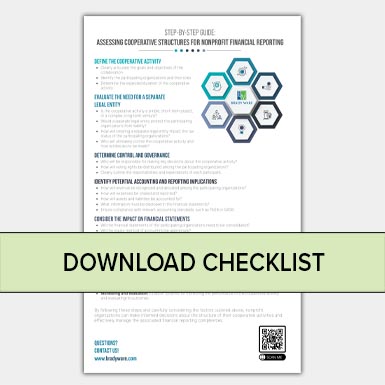
When Cooperation Requires Careful Accounting
The way financial information about a cooperative activity is reported depends on the structure of the nonprofits’ collaboration. Here are some key considerations:
Was a New Legal Entity Created?
- Collaborative Arrangement: If no separate legal entity exists, the reporting nonprofit organization might be part of a collaborative arrangement. In this scenario, costs and revenue between the cooperative activity and third parties are reported on a gross basis if the reporting organization is considered the principal participant.
- Control Changes Hands: If the other entity gains control over the reporting nonprofit organization’s operations, consolidation becomes necessary. This may involve establishing a new basis of reporting for the nonprofit organization’s assets and liabilities. Similar considerations apply if the reporting organization gains control of the other entity.
New Legal Entity Established:
- Merger or Acquisition: When a new legal entity is formed to house the cooperative activity, it’s crucial to determine if this represents a merger or acquisition.
- New Entity Takes Control: If both governing boards relinquish control to the new entity, the reporting nonprofit organization ceases to exist.
- Reporting Organization Loses Control: If only the reporting nonprofit organization loses control, the new entity becomes the acquirer. Similar to the scenario where the other entity gains control, the reporting nonprofit organization may need to establish a new basis for reporting.
Finding the Right Approach with Expert Guidance
While navigating the complexities of financial reporting for collaborative activities can be challenging for nonprofits, the benefits of collaboration often outweigh the difficulties. However, it’s essential to work with your accountants and auditors to determine the appropriate accounting methods and disclosures for your specific situation. This article provides a simplified overview, and professional guidance is crucial for ensuring accurate and compliant financial reporting.
Brady Ware Nonprofit Advisors want to help you fulfill your mission with financial health and compliance services and a network of nonprofit consultants who specialize in strategic decision-making.
Questions?
Jacob manages a variety of accounting, audit, review, and compilation engagements for the firm’s Columbus, Ohio, clients in numerous industries, including Nonprofit, Retail, Construction, and Auto Dealers. He has an extensive background in auditing nonprofit organizations, as well as experience in auditing employee benefit plans.