
Dealerships and FTC Safeguards Rule – DOWNLOAD
Dealerships and the FTC Safeguards Rule: Develop Your Action Plan
The FTC Safeguards Rule is not just another piece of red tape; it is a critical framework for protecting customer information and a non-negotiable legal obligation for automobile dealerships.
In an age of increasing cyber threats, where customer trust is fragile and data breaches are common, a dealership’s ability to demonstrate a robust and proactive commitment to data security can be a significant competitive advantage.
Since dealerships are considered financial institutions due to their involvement in financing, they are prime targets for cybercriminals seeking sensitive financial data. Failure to comply can result in severe financial penalties, lawsuits, and irreversible damage to a dealership’s reputation. While the rule’s comprehensive requirements may seem challenging, they also present a clear direction for action.
The importance of the rule is highlighted by the recent updates that have made it more prescriptive and less ambiguous. Gone are the days when a dealership could get by with general security practices. Now, the rule mandates specific, actionable measures that cover everything from who can access data to how it’s disposed of. For instance, the requirement to encrypt customer information, both while it’s stored on a system (“at rest”) and when it’s being sent to a third party (“in transit”), directly addresses a major vulnerability. Similarly, mandating multi-factor authentication for anyone accessing customer information is a powerful defense against phishing attacks and compromised credentials, which are common entry points for hackers. These detailed mandates leave no room for guesswork, forcing dealerships to prioritize cybersecurity as a core business function.
Another crucial element is the new breach reporting requirement. As of May 2024, dealerships must report security incidents involving the unauthorized acquisition of unencrypted customer information of at least 500 customers to the FTC. This is a game-changer. It shifts the burden of responsibility and creates a direct line of accountability to a federal regulator. For dealerships, this means the consequences of a breach go beyond just dealing with affected customers; they now include a federal investigation, potential fines, and public disclosure of the incident. This increased scrutiny is a powerful motivator for businesses to invest in preventative security measures rather than relying on a reactive approach. The rule effectively transforms a cybersecurity plan from a “nice-to-have” into an essential operational requirement.
The FTC’s rules ensure that dealerships move beyond basic password protection and adopt a holistic security posture that anticipates and mitigates a wide range of threats. Not only will they help dealerships mitigate risk, it is also a marketable aspect to consumers.
Action Items for Dealerships
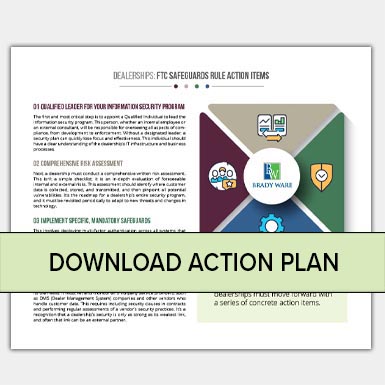
To navigate these new mandates, dealerships must move forward with a series of concrete action items.
ONE: Qualified Leader for Your Information Security Program
The first and most critical step is to appoint a Qualified Individual to lead the information security program. This person, whether an internal employee or an external consultant, will be responsible for overseeing all aspects of compliance, from development to enforcement. Without a designated leader, a security plan can quickly lose focus and effectiveness. This individual should have a clear understanding of the dealership’s IT infrastructure and business processes.
TWO: Comprehensive Risk Assessment
Next, a dealership must conduct a comprehensive written risk assessment. This isn’t a simple checklist; it is an in-depth evaluation of foreseeable internal and external risks. This assessment should identify where customer data is collected, stored, and transmitted, and then pinpoint all potential vulnerabilities. It’s the roadmap for a dealership’s entire security program, and it must be revisited periodically to adapt to new threats and changes in technology.
THREE: Implement Specific, Mandatory Safeguards
This involves deploying multi-factor authentication across all systems that access customer information, ensuring all sensitive data is encrypted, and setting up secure disposal procedures for customer records. Furthermore, dealerships must develop a written incident response plan that outlines a clear strategy for containing a security breach, notifying affected parties, and recovering operations. This plan should be tested regularly to ensure all staff know their roles in an emergency.
FOUR: Have Qualified Third-Party Service Providers
Finally, a dealership’s commitment to the Safeguards Rule extends beyond its own walls. It must vet and monitor all third-party service providers, such as DMS (Dealer Management System) companies and other vendors who handle customer data. This requires including security clauses in contracts and performing regular assessments of a vendor’s security practices. It’s a recognition that a dealership’s security is only as strong as its weakest link, and often that link can be an external partner.
Protecting Your Business and Your Customers
A robust compliance plan for a dealership not only fulfills a legal obligation and helps avoid significant financial penalties, but it also protects the dealership’s reputation and builds customer trust. It ensures that the dealership is prepared for a data breach through a clear response plan, and it mandates essential technical safeguards like multi-factor authentication and encryption. Ultimately, a strong plan is a proactive defense against evolving cyber threats, transforming data security from a liability into a core business asset.
Dealership Experts
Kirk Dahlquist is a automotive industry professional with 47 years of experience in dealership operations, specializing in parts inventory management and service department efficiency. As a former co-owner of Mazda of Roswell in Georgia, he spent 22 years leading the dealership’s parts and service division, optimizing inventory strategies to maintain high fill rates while minimizing waste.