
Client Spotlight: Dayton History
Client Spotlight: Dayton History
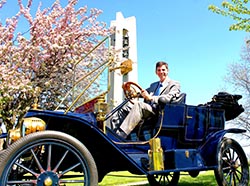 Brady Kress of Dayton History sat down with us to shine a spotlight on what they’re up to. Brady’s first memories of Carillon Park are of listening to the Deeds Carillon bells from the Old River Park at NCR as a small child. In 1988, at just 15 years old, he started working at Carillon Park as a seasonal guide. In 2003, he joined Carillon Park as Executive Director, and in 2005, he stepped up as President and CEO of the newly formed Dayton History organization.
What makes Dayton History Special?
Dayton has so many unique stories to tell. We have worked hard to create an experience that visitors can’t get anywhere else. We have built our foundation on creating a unique visitor experience. We don’t want to repeat an experience that visitors might find in another museum 20 miles down the road; we want to tell Dayton’s stories. At the turn of the 20th century, Dayton businesses held more patents per capita than any other region in the United States. As an example, NCR was one of Dayton’s oldest and largest employers, and the NCR Archive we now own, contains many of these tremendous regional stories you won’t find anywhere else.
Rather than being a part of a City or Metro Park system, Dayton History is a private museum organization. We occasionally receive government grants, but the vast majority of our funding is from private donors. Very little, if any, support comes from a tax base. Maintenance of the grounds, new projects to expand exhibits and experiences, and museum staff are all under Dayton History’s private governance.
Community Involvement
I am delighted with how generous the community is. Dayton History has accomplished quite a bit in the last dozen years, and all of that is donor driven. We have attracted wonderful, generous donors who have sought us out. In many cases, they’re excited about what we do, how we do it, and want to be involved. Some of our biggest donors for the past couple projects weren’t even on the organization’s radar 10 years ago, so that’s an exciting development.
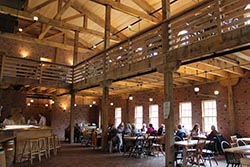 Dayton History also has an army of people committed to the mission, and it’s fun to build something with people who are super jazzed about it. For example, we were almost finished with the master plan for the property when we realized at the eleventh hour that we would not be complete without a brewery. And with the generous help of area families to back it and help us build it, Carillon Brewing Co. came about. And now we have an entire team of people working in the brewery and brewing every day. Many of them can’t believe they get paid to live this dream and that this amazing working brewery exhibit exists. It’s so satisfying to build something and have people’s lives intertwined with it.
Progress is a Process
I have to credit Dayton History’s flexibility to respond quickly to opportunities or issues to our organization’s board of directors. The organization’s board provides excellent governance, allowing the organization to focus on operations, which allows us to be flexible and nimble when opportunities come about. Maintaining a close relationship with an auditor helps us to ensure we’re doing everything we’re supposed to be doing, so we can focus on building the future.
I don’t think Carillon Park will ever be “complete.” We’re always trying to tweak things. A big change early on was to switch from a seasonal summer park to being open year-round, making the park more available to the public. Adding the Heritage Center of Dayton Manufacturing & Entrepreneurship started to change the way people thought of Carillon Park and Dayton History. Starting in 2008, the state and the community went through a lot of changes, with government and business budgets tightening and NCR leaving.
We ended up being an umbrella to other local museums that had previously relied on government agencies to operate, so we grew quickly. We took on management agreements, and as a private nonprofit, we were able to do things more efficiently with fewer expenses than other groups, or even the government, could. And so we started managing the Dunbar House, the Patterson Homestead, Memorial Hall, and the Old Court House. Then the Department of Energy contacted us to build out and operate the Mound Cold War Discovery Center in Miamisburg. And all of these things were able to happen very quickly in a span of five years. We even ran the National Aviation Hall of Fame for about 18 months to help them through the unexpected loss of the leader of that organization.
We now own the Patterson Homestead and Orville Wright’s Hawthorn Hill, which have their own endowments to help take care of them. In recent years, we’ve tried to bring the focus back to Carillon to further our mission and diversify our revenue streams to build new projects. The bottom line of everything we do is to educate with hands-on opportunities to teach our unique stories that you really can’t get anywhere else. Carillon’s success lies with driving traffic to the park. We’re always trying to bring in the public, so we don’t want to offer projects that people could just as easily do inside of a classroom.
I like to hang out in the museum during events to hear what people are saying, where they’re going, and what they’re doing. You can tell for example that some guests to our recent Christmas event didn’t necessarily come here to go through the 1913 Flood Exhibit Experience; they came for hot chocolate and to get a picture with Santa. But then they end up going through the exhibits, and you hear people say, “Oh my gosh! Did you see the whatever, did you know that happened?!” And I know that using a popular draw to help people leave with more information about our community’s history is working to educate people, both on local history and what our organization provides to the community.
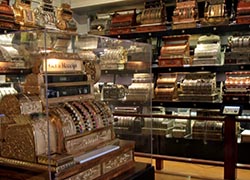 If the last time you came to Carillon Park was with your fourth-grade class, you need to visit us again now. We’re not the Carillon Park of 1975 or 1985 or even of 2005. It’s a much different place with more to see and numerous new exhibits we’ve acquired, including the NCR Archive, the DP&L Collection, the Kettering-Moraine Museum Collection, and the Montgomery County Historical Society Collection. There’s more on exhibit here than ever before, and it increases every month. We recently acquired the Standard Register Archive, and we’re in the process of combing through those artifacts. Standard Register was a major employer in Dayton for 103 years, and I think it’s important for us to tell that story.
Coping With COVID
During the shutdown in 2020, we took advantage of the park being closed to the public and decided to renovate the gift shop. With almost exclusively in-house labor, we tripled the gift shop’s size, which has made a noticeable difference in traffic and sales. And with the Public Health Department’s approval, we were able to hold some of our popular events by the end of 2020.
Like most organizations, we’re feeling the effects of COVID-caused staffing issues, but we’ve fared well. One of our restaurants has remained closed recently strictly because of staffing issues. We know people love the restaurant, and we look forward to being able to re-open it.
Funding by the general public waned, understandably, during the early part of the pandemic as donors focused their giving on pandemic-related causes. Thankfully, we have members and families who have been supportive because we’re telling Dayton’s stories. Maybe their father, or great-grandfather sold a Dayton company 30 or 70 years ago. We’re the holder of their legacy, and they want to help us continue to tell their family’s story.
A Focus on the Future
Keeping our new exhibit job sites open has been a challenge due to the new COVID variant. But we’re hoping that by the end of 2022 we will have some new exhibits up and running. Our goal is to have our new trades area completed, with an expanded print shop and foundry and other factory demonstrations. We’re also creating a new courtyard with a neat little plaza for people to sit in and enjoy.
And by the end of the year, we hope to have our mile-long Carillon Park Railroad track in place with all the excavating, fencing, and landscaping completed. By Fall of 2022, we hope to have our new train delivered from England, a three-foot narrow gauge locomotive with a 12-foot stack, along with tender, and two coaches. It’s 145 feet long, and it will carry 120 people on a narrated tour over a mile-long loop around Carillon Park. It’s the most comprehensive project we’ve ever planned, affecting more of the park than anything we’ve ever done, since the park’s conception.
We’re very excited about the future of Dayton History, and we hope readers will come visit, whether it’s their first time or their fortieth time. We are always evolving to keep the community engaged in Dayton’s unique history.
Brady Ware Nonprofit Advisors want to help you fulfill your mission with financial health and compliance services and a network of nonprofit consultants who specialize in strategic decision-making.