
Business Entity Types: Understanding the Basics
Business Entity Types: Understanding the Pros and Cons for Choosing the Right Structure for Your Business
Choosing the right business entity structure is a pivotal decision for any entrepreneur. This choice significantly impacts legal and financial responsibilities, tax obligations, and overall business operations. This article explores some of the most common business entity structures, including sole proprietorships, partnerships, limited liability companies (LLCs), and corporations (C and S corporations), delving into their key characteristics, advantages, and disadvantages to assist in informed decision-making.
What is a Sole Proprietorship?
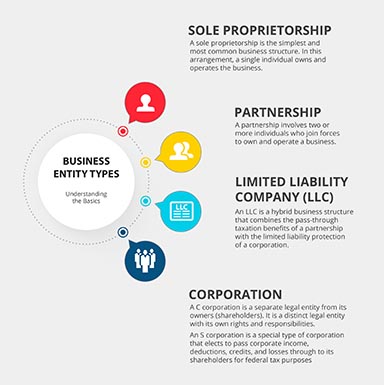
A sole proprietorship is the simplest and most common business structure. In this arrangement, a single individual owns and operates the business.
Pros of a sole proprietorship
Sole proprietorships offer several advantages. Firstly, they are incredibly easy and inexpensive to form, requiring minimal legal formalities. Secondly, they provide the owner with maximum control and flexibility in decision-making. Finally, sole proprietorships enjoy pass-through taxation, meaning business profits and losses are reported on the owner’s personal tax return, avoiding double taxation.
Cons a sole proprietorship
While offering simplicity, sole proprietorships also carry significant risks. The most significant disadvantage is unlimited liability, where the owner is personally responsible for all business debts and liabilities. This means personal assets, such as savings and personal property, are at risk if the business incurs debts or faces legal challenges. Additionally, raising capital can be challenging for sole proprietorships, as securing loans or attracting investors may be difficult. Finally, the lifespan of a sole proprietorship is limited, as it typically dissolves upon the owner’s death or incapacity.
What is a Partnership?
A partnership involves two or more individuals who join forces to own and operate a business.
Pros of a partnership
Partnerships offer several benefits. By combining their skills, capital, and resources, partners can leverage diverse expertise and increase their chances of success. Similar to sole proprietorships, partnerships generally enjoy pass-through taxation, where profits and losses are passed through to the partners’ individual tax returns. Furthermore, partnerships are relatively easy to form compared to corporations, requiring less complex legal procedures.
Cons of a partnership
Partnerships also carry inherent risks. In general partnerships, all partners are personally liable for the business’s debts, exposing their personal assets to significant risk. Moreover, the potential for disagreements among partners is a significant concern, as conflicts can arise over decision-making, profit distribution, and other crucial aspects of the business, potentially leading to dissolution. Additionally, partners may face joint and several liability, meaning each partner is individually responsible for the entire partnership’s debts, even if they were not directly involved in the actions that led to the debt.
“Choosing the right business entity structure is a pivotal decision that significantly impacts legal and financial responsibilities, tax obligations, and overall business operations.”
What is a Limited Liability Company (LLC)?
An LLC is a hybrid business structure that combines the pass-through taxation benefits of a partnership with the limited liability protection of a corporation.
Pros of an LLC
LLCs offer several key advantages. Most notably, they provide limited liability protection to their owners (members), meaning members are not personally liable for the business’s debts. This significantly reduces personal financial risk. Similar to partnerships and sole proprietorships, LLCs generally enjoy pass-through taxation, allowing profits and losses to pass through to the members’ individual tax returns. Furthermore, LLCs offer flexibility in terms of management structure and tax treatment, allowing owners to choose how they want to operate and be taxed.
Cons of an LLC
While offering numerous benefits, LLCs also have some potential drawbacks. Members of an LLC may be subject to self-employment tax on their share of profits, which can increase their overall tax burden. Additionally, LLC laws can vary significantly from state to state, potentially creating complexities in managing and operating the business across different jurisdictions. In certain situations, if an LLC elects to be taxed as a corporation, it may be subject to double taxation, similar to C corporations.
What is a Corporation (C Corporation)?
A C corporation is a separate legal entity from its owners (shareholders). It is a distinct legal entity with its own rights and responsibilities.
Pros of a C corporation
C corporations offer several advantages. Shareholders are not personally liable for the corporation’s debts, providing significant protection for their personal assets. C corporations have perpetual existence, meaning they continue to exist even if ownership changes. This ensures business continuity and facilitates long-term planning. Furthermore, C corporations have the ability to issue stock to raise funds from investors, making it easier to secure capital for growth and expansion.
Cons of a C corporation
C corporations are subject to double taxation, meaning corporate profits are taxed at the corporate level, and then dividends paid to shareholders are taxed again at the individual level. This can significantly increase the overall tax burden for the business and its owners. Additionally, C corporations are more complex and expensive to form and maintain than other business structures. They require more extensive record-keeping, administrative requirements, and compliance with various regulations. Finally, C corporations are subject to greater regulatory oversight and government scrutiny compared to other business structures.
What is an S Corporation?
An S corporation is a special type of corporation that elects to pass corporate income, deductions, credits, and losses through to its shareholders for federal tax purposes
Pros of an S corporation
S corporations offer the limited liability protection of a traditional corporation while also enjoying pass-through taxation, similar to partnerships and LLCs. This avoids the double taxation that typically occurs with C corporations.
Cons of an S corporation?
S corporations are subject to certain restrictions. They are limited to 100 shareholders who must be U.S. citizens or residents. Additionally, S corporations must meet specific eligibility requirements to qualify for this tax status, which can sometimes be complex and restrictive.
A Crucial Decision
Choosing the right business entity structure is a crucial decision with far-reaching implications. By carefully considering the advantages and disadvantages of each option, entrepreneurs can select the structure that best aligns with their business goals, risk tolerance, and long-term vision.
Disclaimer: This article provides general information and should not be considered professional financial or tax advice. Please consult with a qualified CPA or financial advisor for guidance specific to your individual business needs.
Questions?
Eric Carter focuses on developing and implementing financial and tax planning strategies for his clients. He spends most of his time in consulting work, helping clients with compliance, buying and selling business, and other transactional needs. Eric also helps lead the firm’s business advisory services, providing customized tax services and consulting for small-market business clients.