
ASC 842 Implementation & Compliance
Navigating ASC 842: Comprehensive Guide to Reporting Leases on the Balance Sheet
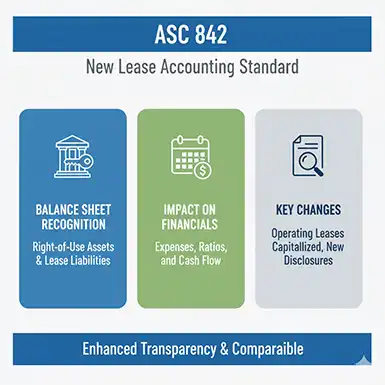
ASC 842, the new lease accounting standard, fundamentally changes how companies report leases by requiring lessees to recognize nearly all leases on the balance sheet as both a Right-of-Use (ROU) asset and a corresponding lease liability, which necessitates a thorough analysis of implementation, rigorous evaluation of the lease portfolio’s accuracy, proper classification and measurement, and strong controls over the entire accounting process to ensure compliance. This shift from the old standard, ASC 840, eliminates the widespread use of off-balance-sheet operating leases, providing investors and creditors with a much clearer view of a company’s total financial obligations. Successfully transitioning and maintaining compliance is a significant undertaking that requires careful project management, specialized technology, and robust internal controls.
Key Takeaways
What is the biggest change ASC 842 makes to financial statements?
ASC 842 requires companies to recognize nearly all leases on the balance sheet as a Right-of-Use asset and a corresponding lease liability.
What are the two main types of leases under ASC 842 for lessees?
The two main lease types for lessees under ASC 842 are finance leases and operating leases.
What is the most common risk in ASC 842 compliance?
A common risk in ASC 842 compliance is failing to identify and account for all embedded leases and subsequent lease modifications.
Analyzing the Entity’s Implementation of ASC 842
The journey to compliance begins with a deep analysis of the entity’s implementation of ASC 842 and its impact on lease accounting. For most organizations, this was a massive undertaking, involving cross-functional teams from accounting, real estate, treasury, and IT. The implementation phase often includes selecting and configuring specialized lease accounting software, gathering all relevant lease contracts (which may number in the hundreds or thousands), and making critical policy elections, such as choosing the discount rate methodology or determining the practical expedients to apply. The impact is felt across the financial statements, particularly the balance sheet, but also in the income statement (shifting from straight-line rent expense to ROU asset amortization and interest expense) and cash flow statements. A thorough review assesses whether the initial system configuration and policy choices align with both the standard’s requirements and the company’s operational reality. Any gaps here can lead to systemic errors that cascade throughout the reporting process.
Evaluating the Accuracy and Completeness of the Lease Portfolio and Disclosures
A core challenge of ASC 842 is the requirement for accuracy and completeness of the lease portfolio and related disclosures. Under ASC 840, many simple operating leases were tracked outside of the general ledger system. Now, every qualifying lease—from office space and company cars to specialized equipment—must be identified, documented, and accurately input into the accounting system. The sheer volume and complexity of lease agreements make this a common point of failure. An evaluation must confirm that all lease agreements have been captured, including embedded leases (arrangements that convey the right to control the use of an identified asset within a service contract). Furthermore, ASC 842 demands extensive qualitative and quantitative disclosures, which must clearly explain the nature of the entity’s leasing activities, its judgments, and the key inputs used in calculating ROU assets and lease liabilities. Incomplete or inaccurate disclosures can be as detrimental to compliance as balance sheet errors.
Assessing the Appropriateness of Lease Classification and Measurement
A fundamental step in maintaining compliance is to assess the appropriateness of lease classification and measurement. ASC 842 simplifies classification by having only two types for lessees: finance leases (similar to former capital leases) and operating leases. The classification criteria—which largely revolve around whether the lease substantially transfers control of the underlying asset—significantly impact income statement expense recognition.
Ensuring Accurate Measurement Inputs
Measurement is a particularly complex area. It requires accurate determination of the lease term (including renewal and termination options reasonably certain to be exercised) and the discount rate (either the rate implicit in the lease or the lessee’s incremental borrowing rate). Errors in these inputs can lead to material misstatements of both the ROU asset and the lease liability. This assessment ensures that the calculations reflect the underlying economics of the lease agreement and adhere to the standard’s strict guidance on key inputs.
“Successfully transitioning and maintaining compliance is a significant undertaking that requires careful project management, specialized technology, and robust internal controls.”
Reviewing the Effectiveness of Controls over Lease Accounting Processes
Robust compliance hinges on reviewing the effectiveness of controls over lease accounting processes. Given the reliance on specialized software and the complexity of the required judgments, weak controls pose a serious risk. Effective controls should span the entire lease lifecycle:
- Identification: Controls to ensure all new contracts are reviewed for embedded leases.
- Input/Data Integrity: Controls over the accurate input of key lease terms (e.g., payments, term, discount rate) into the software.
- Calculation/Processing: Controls to ensure the lease software’s calculations align with company policy and ASC 842.
- Reporting: Controls over the generation and review of financial statement line items and required disclosures.
Documenting and regularly testing these controls is crucial, not just for external audits but for providing management with assurance that the lease data is reliable and that the risk of misstatement is low.
Identifying Potential Risks and Providing Remediation
The final step in the ASC 842 compliance lifecycle is to identify potential risks related to lease accounting misstatements and provide recommendations for remediation. Common risks include:
Data Migration Errors
Inaccuracies stemming from the initial transfer of lease data from spreadsheets or old systems into the new software.
Missing Amendments
Failure to consistently capture and account for lease modifications, which often require complex remeasurement.
Inappropriate Discount Rate Usage
Using an outdated or incorrectly calculated incremental borrowing rate.
Recommendations must be specific and actionable, such as implementing a formal internal review process for all lease modifications before they are processed, or requiring mandatory annual training for personnel responsible for identifying embedded leases. This proactive approach ensures continuous improvement, mitigating future risks and strengthening the overall control environment to maintain long-term ASC 842 compliance.
Sustaining Long-Term ASC 842 Compliance
Ultimately, achieving and sustaining ASC 842 compliance is an ongoing governance and process challenge, not just an accounting hurdle. By systematically analyzing the initial implementation, rigorously evaluating the completeness and accuracy of the lease portfolio, confirming appropriate classification and measurement inputs, and establishing robust controls over the entire lifecycle, companies can move beyond the initial heavy lift of transition. This diligence ensures that the financial statements accurately reflect all leasing obligations, satisfying regulatory requirements and providing stakeholders with transparent and reliable financial information crucial for informed decision-making.
Disclaimer: This article provides general information and should not be considered professional financial or tax advice. Please consult with a qualified CPA or financial advisor for guidance specific to your individual business needs.
Questions?
Kelly has expertise in audit, review, and compilation services across diverse industries, including nonprofit organizations, construction, manufacturing, and technology. Kelly possesses an extensive background in auditing nonprofit organizations, particularly those receiving federal funding.