
US Entity Options for Foreign Companies
Choosing the Right Entity for In-Bound Foreign Companies
When a foreign company ventures into the United States, selecting the appropriate legal entity structure is a crucial decision. This choice significantly impacts factors such as taxation, liability, regulatory compliance, and overall operational efficiency.
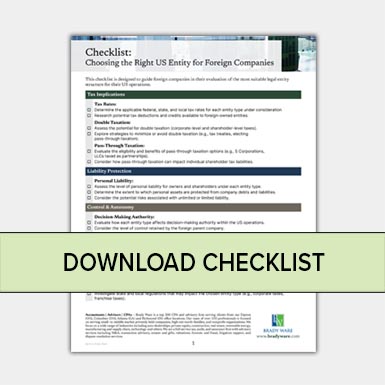
Check out this downloadable checklist for evaluating the most suitable legal entity structure for your US operations.
Understanding the Options
The available entity options for foreign companies entering the U.S. market are diverse, each with unique characteristics and implications.
Corporations: C-Corps and S-Corps
Corporations offer limited liability to shareholders, meaning their personal assets are generally protected from company debts. C Corporations are the most common type for foreign companies, but they are subject to double taxation, where corporate profits are taxed at the company level and again when distributed to shareholders as dividends. S Corporations offer a pass-through tax treatment, allowing profits and losses to flow directly to shareholders, thus avoiding double taxation. However, eligibility for S Corporation status has limitations, including restrictions on ownership and the number of shareholders.
Limited Liability Companies (LLCs)
Limited Liability Companies (LLCs) provide flexibility in terms of taxation and management. Single-Member LLCs are typically treated as disregarded entities for tax purposes, meaning profits and losses flow through to the owner’s personal income tax return. Multi-Member LLCs offer more flexibility, allowing them to be taxed as either partnerships or corporations. Choosing the partnership taxation option can effectively avoid double taxation.
Partnerships
Partnerships are characterized by shared ownership and responsibility. General Partnerships involve all partners sharing in both profits and losses, as well as unlimited liability for the partnership’s debts. Limited Partnerships have at least one general partner with unlimited liability and one or more limited partners with limited 1 liability.
“Selecting the most suitable entity structure for an in-bound foreign company is a complex process. It is crucial to consult with legal and tax professionals to assess the specific circumstances of the company and provide tailored advice.”
Branch Offices
Branch Offices are extensions of a foreign parent company, operating within the U.S. while remaining part of the parent entity for tax purposes. Profits generated by a branch office are typically taxed in the parent company’s home country.
Subsidiaries
Subsidiaries are separate legal entities, wholly or partially owned by the foreign parent company. They can be structured as corporations, LLCs, or partnerships and are subject to U.S. taxation as independent entities.
Key Considerations for Entity Selection
Choosing the optimal entity structure requires careful consideration of several key factors. The chosen entity will significantly impact the company’s tax obligations, including factors such as tax rates, deductions, and the potential for double taxation. The level of personal liability for the company’s owners varies significantly across different entity types. Different entities may be subject to varying degrees of regulatory oversight, including licensing, permitting, and compliance with specific industry regulations. The desired level of control over the U.S. operations will influence the choice of entity, including factors such as ownership structure and decision-making authority. The company’s long-term growth plans and potential for expansion should be factored into the entity selection process. The chosen structure should be adaptable to future needs and accommodate potential changes in ownership or operations.
Seeking Professional Guidance
Selecting the most suitable entity structure for an in-bound foreign company is a complex process. It is crucial to consult with legal and tax professionals to assess the specific circumstances of the company and provide tailored advice. By carefully evaluating the available options and seeking expert guidance, foreign companies can establish a solid foundation for their U.S. operations and maximize their chances of success.
Disclaimer: This article provides general information and should not be considered professional financial or tax advice. Please consult with a qualified CPA or financial advisor for guidance specific to your individual business needs.
Questions?
Rose is a tax professional with over a decade of experience, specializing in international taxation. She advises individuals and businesses, particularly pass-through entities, on a wide range of tax matters. She assists clients with complex international tax issues, including those with foreign ties. Rose focuses on client-centric solutions and aims to be a trusted advisor for her clients and their networks.