
An Overview of Patent and Royalty Licensing Rates
Treated Like Royal(ties): An Overview of Patent Licensing Rates
If the market for small, privately held companies is opaque, then the market for licensing transactions is nearly invisible. When licensing a patent, all most licensors and licensees have to go on is their own experience and that of their legal counsel.
There’s nothing wrong with this but it’s a little like spending your life within 10 miles of one town and then assuming that the rest of the world is pretty much like that one small part of the planet. A broader understanding of market activity is often quite valuable in negotiations.
The 25% Rule and Market Reality
Not too long ago, players in the patent world were fond of using the “25% rule.” The 25% rule says that a patent royalty rate should be somewhere in the neighborhood of 25% of the licensee’s EBITDA margin. But that went by the wayside about a decade ago, and probably with good reason. Decades ago, that might have been a reasonable benchmark that was loosely connected to market pricing, it probably signals market reality only by accident nowadays.
If you have ever found yourself in that position or think you might at some point, bookmark this article because you’ll want to refer to this chart.
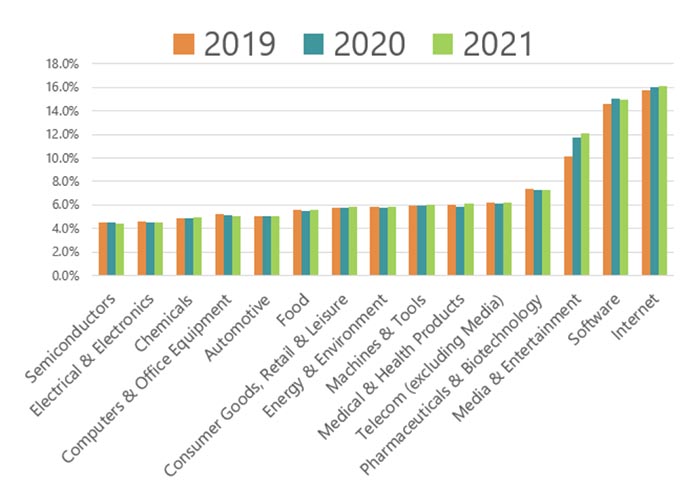
In it, you can get a sense for the average royalty rates across several industries, which you can use to calibrate your expectations for a licensing deal you are considering. It’s interesting to note that, for the most part, royalty rates don’t change a lot over time. The one mover is in media, and I think that is a function of the increased demand for content by the proliferation of numerous streaming channels. However, the royalty rate data contained in this chart should remain similar for a few years at least.
Causes for Royalty Rate Variations
Remember, however, that averages, are just that—averages. Royalty rates can and do vary widely from licensing deal to licensing deal. The causes for such variations include the following:
- Exclusivity – How many licensees can, or will there be?[1]
- Protection and Litigation – Who is responsible for protecting the patents and bringing litigation upon
infringers?[2] - Upfront/milestone payments – How much will be paid in lump sums that are not connected with sales?[3]
- Geographic Coverage – Where does the license confer exclusivity?[4]
- Relative bargaining power between licensor and licensee – Is the patent owner an individual inventor or an enterprise? Inventors tend to have relatively little bargaining power.
- The strength of the patent(s) – How strong are the patents in terms of resisting an attempt to have them nullified in Court? How expansive are the claims? How many forward citations are there? How difficult would it be to simply invent around the claims?
- The size of the patent portfolio? – Patents are like wolves – they tend to be more powerful in packs.[5]
- Whether the licensing agreement includes marketing assets, such as trademarks and trade names – Patent licenses without branding rights may be less valuable.
And, of course, like any deal, there can be any number of random factors involved in achieving the final price and terms, such as the weather the day you negotiate the deal or what the people involved had for breakfast.
Nevertheless, we find that data points like this enable a degree of clarity that strengthens our clients’ bargaining positions simply by understanding market pricing for patent licensing agreements. When you know if a proposed deal is above, below, or at the market thanks to empirical data, your decision process is simplified.
Footnotes:
[1] Exclusive licenses are rare but when they exist they are associated with higher royalty rates.
[2] If the licensee is responsible for protecting the intellectual property, the royalty rate will likely be lower.
[3] The greater the upfront/milestone payment, the lower the royalty rate.
[4] The wider the coverage, the higher may be the royalty rate.
[5] Larger portfolios tend to command higher higher royalty rates.
Questions?
Brady Ware offers a comprehensive range of advisory services, including strategic advisory, financial analysis, tax compliance, litigation support, employee stock ownership plans, succession planning, mergers and acquisitions, quality of earnings analysis, tax structuring, and business valuations. Our team of experienced professionals provides tailored solutions to help clients achieve their financial goals, minimize risks, and optimize their business performance. Brady Ware’s advisory services focus on developing solutions and creating pathways to success for businesses facing complex challenges, leveraging their deep understanding of business operations, transactional situations, and personal and ownership legacies.