
Is Measuring KPIs Worth It?
Chart of the Month: Is Measuring KPI's Worth It or Just a Pain in the A--?
In the 13 months plus since I have been leading Brady Ware Arpeggio, I have learned an important lesson: measurement is management. And while it can make you popular enough to have a democratic, transparent culture (which we do) and to support employees’ working wherever they feel the most effective (which we do), popularity doesn’t always lead to profits.
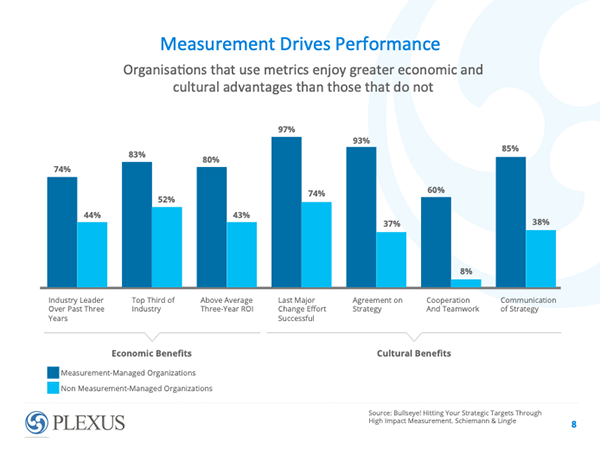
What leads to profits?
Measurement of performance does lead to profits. This neat chart from Plexus illustrates the benefits of performance measurement. When you measure performance, you are much more likely to:
- Be an industry leader
- Produce above average return on investment
- Successfully push through changes
We have a weekly scorecard that we work from, and everyone is accountable to it. Everyone can see everyone else’s time sheets, including mine. (I have been told this is dangerous, but the benefits outweigh the risks). That scorecard has evolved over a year of use, with experiences just as I described. Some metrics were changed. Some measurements were changed. Some goals were changed as we discovered some goals were too easy and others were unrealistic. And when people fall short of their KPI goals, we look for opportunities to help people get back on track.
You’re more likely to make extraordinary contributions if those contributions are measured, rewarded, and acknowledged.
Performance Measures Motivate
I can tell you from experience, and from having read many books on this topic (Traction, 4DX: The Four Disciplines of Execution, among others) that performance measurement motivates. You aren’t motivated to win a game if you don’t know what winning looks like or even what the score is. You’re less likely to freeload if you’re being measured. You’re more likely to make extraordinary contributions if those contributions are measured, rewarded, and acknowledged.
Some companies avoid performance measurement because they have experience where it has been weaponized: it is used to tear someone down, not lift them up. Unfortunately, too many organizations do just that.
When can measuring performance backfire?
Measuring performance backfires when your employees don’t realize that is the metric by which their performance is measured. When you don’t provide the training and support needed to maximize employees’ performance to that metric and you don’t share that metric often with your employees.
When you don’t know where you’re headed, you can’t tell if you’re making headway, and you can’t tell if you’re making an impact, performance measurement demotivates, rather than motivates. You have to give your people a fighting chance to succeed. When you do, they often will.
We are struck by how frequently our valuation clients don’t have or track meaningful key performance indicators. Sure, they track revenue and profit and certain expenses, but those are known after the fact. Robust KPIs predict revenue and profit weeks or even months in advance.
Getting Started
If you’re instituting metrics for the first time, allow for some time for the process to take hold because it will take time for your employees to understand the metric, to believe that you truly will hold them accountable for the metric, and for training to cause employee behavior to adapt to achieving the metrics. You may also learn that your initial metrics don’t matter as much as you thought they did, and you need different metrics. Or you may find it difficult to measure the metrics correctly and timely.
If you’re not sure what to track, ask people in your business what they think makes it tick. Research KPIs for businesses in your industry on the Internet. Even artificial intelligence tools like ChatGPT could help.
The chart says it all—companies that track KPIs consistently outperform those that don’t, and by a large margin. If you’re looking to improve your company’s performance, consider what performance you track, and how.
Questions?
Brady Ware offers a comprehensive range of advisory services, including strategic advisory, financial analysis, tax compliance, litigation support, employee stock ownership plans, succession planning, mergers and acquisitions, quality of earnings analysis, tax structuring, and business valuations. Our team of experienced professionals provides tailored solutions to help clients achieve their financial goals, minimize risks, and optimize their business performance. Brady Ware’s advisory services focus on developing solutions and creating pathways to success for businesses facing complex challenges, leveraging their deep understanding of business operations, transactional situations, and personal and ownership legacies.