
Is It too Late to Sell Your Company?
Is It too Late to Sell Your Company?
Many people are telling us that they’d like to sell their company, but they feel they missed the boat once the Federal Reserve started raising interest rates to lower inflation.
While I can understand the sentiment, taking that blanket position may be a mistake. It requires a self-assessment to determine whether the current economic environment creates a prohibitive barrier to your exit. We have identified three critical checkpoints to make that determination:
- Is your company generating good cash flow?
- Who is the most likely buyer?
- Does the company offer non-financial value?
Question 1 – Is your company generating good cash flow?
One of the most fundamental questions all business executives face is whether to pursue growth or profitability (and, by extension, cash flow). For the last decade or so, the answer has been growth as the market was happy to defer profitability in exchange for pursuing high growth.
However, when markets experience downturns, everybody is about profitability quickly. Companies (including prospective buyers) want cash flow as a bulwark against the pain that difficult economic conditions that recessions and economic instability often bring. Your cash flow may be a hedge against tough times, and your company’s cash flow might help shore up the cash flow of your acquirer, reducing its own risk profile and making it more resilient in the face of challenging economic conditions.
As a result, we are seeing a flight to quality, just as happens in the public equity markets. When times are good, we love the sexy, high-flying companies, and we muse about whether Warren Buffet has lost his touch or lost touch with the modern economy. But when times turn tough, buyers are going to line up for your cash flow and pay a premium for it. If your company has strong cash flow, and you have been wondering if you made the right decision to emphasize profits over growth in the past, this may be the perfect time to sell.
Question 2 – Who is the most likely buyer?
This directly relates to interest rates. While individuals and small businesses find their strategic choices at least partially shaped by interest rates, that is less likely to be the case for large, financially sound companies. Such companies receive the very best interest rates from banks, and their cost of equity goes up relatively less than other companies when the markets turn negative. They probably don’t even bother to issue debt to the public markets unless they think they can get an exceptional bargain.
Such firms don’t find that the cost or ability to finance acquisitions materially constrains their capacity to buy companies. If anything, they are more motivated to buy because they have a competitive advantage over companies who are so constrained. Therefore, if you think that a large, blue-chip firm is the most likely buyer for you, the chances are their appetite to buy your company was not weakened by the current economic climate.
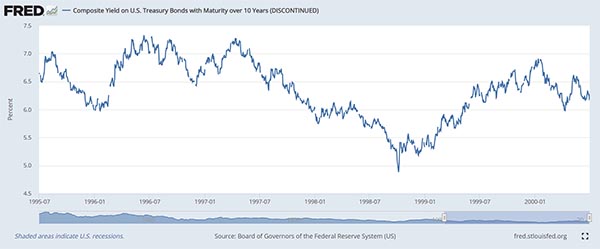
It’s also worth noting that, although interest rates are higher than they have been in recent history, never really recovering after the advent of quantitative easing, they are still moderate by historical standards, as shown in the chart below.
Question 3 – Does the company offer non-financial value?
Sometimes, a company just needs to buy yours. The need for a company to acquire your company most frequently arrives when your company owns a key strategic asset, such as software or a patented technology. Either you’re an existential threat to a company’s business, or you are a roadblock to entering a business that the acquiring company deems desirable. Alternatively, perhaps you represent an asset that a competitor of the acquiring company might buy, strengthening that competitor’s position.
Whatever the specific scenario, the value thesis for the acquirer is not strictly financial, but strategic, and that strategic imperative is unlikely to be closely linked to the current or short-term economic picture.
If you have decided not to try to sell your company strictly because the economic environment isn’t perfect, you may want to re-think that position.
Life for companies goes on even in tough times, and weak economic conditions don’t impact everyone equally. Some companies even benefit from them. This framework can help you understand whether you can sell your company for an attractive price.
But, if you need more analysis and clarity, we can help you think it through.
Questions?
Brady Ware offers a comprehensive range of advisory services, including strategic advisory, financial analysis, tax compliance, litigation support, employee stock ownership plans, succession planning, mergers and acquisitions, quality of earnings analysis, tax structuring, and business valuations. Our team of experienced professionals provides tailored solutions to help clients achieve their financial goals, minimize risks, and optimize their business performance. Brady Ware’s advisory services focus on developing solutions and creating pathways to success for businesses facing complex challenges, leveraging their deep understanding of business operations, transactional situations, and personal and ownership legacies.