
The Most Common Form 990 Mistakes Nonprofits Make (DOWNLOAD)
Essential Tips to Avoid IRS Filing Errors and Penalties
The most common Form 990 mistakes nonprofits make include filing the incorrect form version for their gross receipts, failing to attach required supplemental schedules (particularly Schedules A, B, and O), and leaving mandatory data fields or “total” lines blank. To ensure compliance, organizations must verify their Employer Identification Number (EIN), answer all “Yes/No” questions in the checklist of required schedules, and provide a valid signature from an authorized officer. Avoiding errors is critical, as incomplete or inaccurate filings can lead to IRS rejection, the loss of tax-exempt status, or daily failure-to-file penalties.
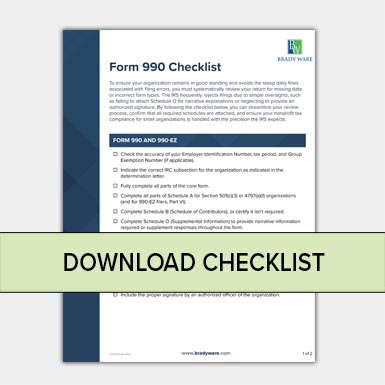
Top Form 990 Filing Errors to Avoid
- Selecting the Incorrect Form Version: Choosing a form (like the 990-EZ) when your organization’s gross receipts or specific entity type require the full Form 990.
- Missing Supplemental Schedules: Failing to include essential attachments, most notably:
- Schedule A: Required for all 501(c)(3) public charities.
- Schedule B: Required for listing contributors (or certifying that a list isn’t required).
- Schedule O: The narrative explanation section that provides context for your financial data.
- Leaving Blank Data Fields: Leaving mandatory lines or “total” lines empty rather than entering a zero (0).
- Incorrect Foundational Data: Errors in the Employer Identification Number (EIN), tax period, or Group Exemption Number.
- Incomplete “Yes/No” Checklists: Failing to answer every question in the Part IV checklist of required schedules.
- Missing Authorized Signature: Submitting the return without a valid signature from an authorized officer.
- Outdated Form Usage: Filing on a form designed for a different tax year than the one being reported.
- Balance Sheet Discrepancies (990-PF): For private foundations, failing to complete all columns in Part II if assets exceed $5,000.
Selecting the Correct Form and Period
One of the first hurdles a nonprofit faces is simply picking the right piece of paperwork. The IRS offers several versions of the Form 990, and selecting the wrong one is a frequent reason for rejection. You must exercise due diligence in selecting the appropriate Form 990 return each year based on your organization’s financial activity. For instance, while smaller organizations might look toward the 990-EZ, it is important to remember that certain organizations are strictly prohibited from using this shorter version regardless of their income. Always double-check that you are using the return specifically designed for the tax period you are filing for, as using an outdated form is an immediate red flag for the IRS.
Navigating Core Form and Schedule Errors
Once you have the right form, the “meat” of the filing requires extreme attention to detail. Missing or incomplete schedules are among the most common errors causing the rejection of a Form 990 return. For Section 501(c)(3) organizations, Schedule A is non-negotiable and must be completed in its entirety. Furthermore, every filer must address Schedule B regarding contributors; if you aren’t required to list donors, you must explicitly certify that it isn’t required rather than just leaving it out.
A frequently overlooked section is Schedule O, which serves as the narrative catch-all for the return. The IRS uses this schedule to allow organizations to provide the “why” and “how” behind their numbers. If the form prompts you for a narrative explanation and Schedule O is missing, the return is considered incomplete. To avoid these pitfalls, nonprofit tax compliance for small organizations often hinges on completing the Part IV checklist of required schedules first, which acts as a roadmap for the rest of the filing process.
Key Takeaways
What happens if a nonprofit fails to file Form 990 for three years in a row?
If a nonprofit fails to file its required Form 990 for three consecutive years, the IRS will automatically revoke its tax-exempt status as of the filing due date of the third year’s return.
How much are the IRS penalties for filing a Form 990 after the deadline?
Daily penalties for late filings typically range from $20 to $120 per day, depending on the organization’s gross receipts, and can accumulate into thousands of dollars if left unaddressed.
Which supplemental schedules are most commonly required for a standard Form 990 filing?
The most frequently required schedules are Schedule A for public charity status, Schedule B for listing contributors, and Schedule O for providing mandatory narrative explanations.
Precision in Data Entry and Signatures
The IRS processing systems are rigid, meaning that even a small omission can trigger a system-generated rejection. You should always include an entry on all total lines, entering a zero (0) when appropriate rather than leaving the space blank. Accuracy extends to your foundational data as well—ensure your Employer Identification Number (EIN), tax period, and Group Exemption Number are correct and match your determination letter.
An often-forgotten final step is the signature. A Form 990 is not considered a legal filing unless it includes the proper signature by an authorized officer of the organization. While you are being thorough, however, remember to omit any unnecessary personal-identifying information, such as Social Security numbers, as these forms are public records. Staying diligent about IRS reporting requirements for 501(c)(3) entities ensures that your public profile remains professional and your tax-exempt status stays secure.
Specific Challenges for Private Foundations (990-PF)
Private foundations face a slightly different set of rules under Form 990-PF. Accuracy in the balance sheet is a common sticking point; specifically, you must complete all of Part II, columns A, B, and C if the foundation’s total assets are $5,000 or more at any time during the year. If assets fall below that threshold, requirements for column C are reduced, but accuracy remains paramount.
Foundations must also pay close attention to Part IX regarding Minimum Investment Return and Part XIV for supplementary information. Much like the standard 990, the 990-PF requires a clear “Yes,” “No,” or “N/A” for every question. Falling behind on private foundation annual filing requirements can be particularly expensive, so ensuring every line—especially the contributor schedule—is addressed is a vital part of your annual financial health check.
Final Thoughts on Avoiding Penalties
Meticulous preparation and review of Form 990 returns are crucial to prevent errors that could lead to rejection or return of the filing. Beyond the administrative headache of a rejected return, the financial stakes are high. The IRS imposes failure-to-file penalties that can range from $20 to $120 per day for larger organizations, which can quickly drain a nonprofit’s hard-earned resources.
By systematically reviewing the checklist of required schedules and ensuring that every narrative and numerical field is addressed, you can maintain a clean record with the IRS. If you find the process overwhelming, seeking professional nonprofit tax preparation services can provide an extra layer of security. Taking the time to get it right the first time is always more cost-effective than correcting a mistake after a penalty notice arrives in the mail.
Brady Ware Nonprofit Advisors want to help you fulfill your mission with financial health and compliance services and a network of nonprofit consultants who specialize in strategic decision-making.
Questions?
Nonprofit Tax Services
Matt specializes in providing strategic tax compliance and consulting for nonprofit organizations. He leverages his deep expertise in IRS reporting requirements to help nonprofits maintain their tax-exempt status while identifying opportunities for tax optimization.