
Adapting to a Digital-First Customer Journey – DOWNLOAD
Six Core Strategies for Dominating the Digital-First Car Buyer Journey
By Justin Ward
The transition to a digital-first customer journey demands a complete overhaul of the car dealership’s marketing focus, shifting resources and strategy from driving physical showroom traffic to maximizing online engagement. This is necessary because modern car buyers conduct the vast majority of their research—an average of 14 hours—online, often arriving at the dealership having already decided on a specific model and price. The new goal is to capture the buyer during this extensive research phase and guide their journey seamlessly.
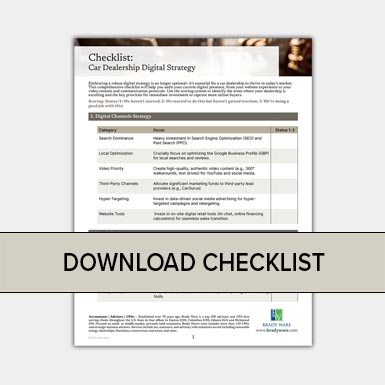
Master your digital approach around these core areas:
Regardless of where your dealership is in the digital journey to attracting customers and closing deals, there are several opportunities to strengthen and advance this important strategy. Read more to gain ideas on how to leverage these areas:
- Digital Channels Strategy
- Your Website
- Transforming the Digital Showroom and Retail Experience
- Prioritizing Real-Time, Personalized Communication
- Leveraging Content for Authority and Trust
- Mastering Hyper-Targeted Digital Advertising
- Initial Interest to Closing the Deal Digitally
Digital Channels Strategy
A car dealership can strategically invest in digital channels where over 90% of buyers conduct extensive research by implementing an omnichannel strategy that dominates search visibility and provides rich, interactive content. This starts with heavy investment in Search Engine Optimization (SEO) and Paid Search (PPC) to ensure the dealership’s website appears for both general vehicle research and high-intent, local “near me” searches, with a crucial focus on optimizing their Google Business Profile (GBP), which is a primary source of local information and reviews. To address the dominance of video in the research phase—where 75% of shoppers are influenced—dealerships must prioritize creating high-quality, authentic video content on YouTube and social media platforms like Facebook and Instagram, showcasing 360° vehicle walkarounds and personalized test drives. Finally, investments must be made in the digital retail tools on their own website—such as AI-powered chat and online financing calculators—to ensure the research phase seamlessly transitions into a personalized sales engagement and efficient purchase completion.
Your Website
A car dealership’s website serves as its most critical digital first impression, making a user-friendly design paramount because modern buyers judge the entire dealership experience based on their online interaction. With most customers conducting extensive research before visiting, a smooth, intuitive website immediately conveys professionalism and transparency, contrasting with a frustrating site that can lead a prospect to believe the in-person experience will be equally difficult. To make an effective first impression, the site must feature fast load times and be perfectly mobile-optimized, as the majority of searches occur on phones. Crucially, it must act as a seamless virtual showroom, offering high-quality visuals like 360-degree views of every vehicle and easily accessible, transparent pricing and financing tools. If the website is slow, hard to navigate, or lacks key information, the dealership loses credibility, and the potential customer will simply bounce to a competitor that offers a better, more trustworthy online experience.
Because the customer journey is non-linear and often self-directed, dealerships must be available to engage 24/7.
Transforming the Digital Showroom and Retail Experience
The dealership website must evolve into a comprehensive virtual showroom and retail hub, no longer just an online brochure. To simulate the physical experience, marketing efforts must prioritize creating immersive vehicle content. This includes investing in 360° vehicle walkarounds for every car in inventory, providing both interior and exterior views that allow for virtual exploration. Crucially, the strategy must heavily feature high-quality video content, as most buyers now watch test drives, feature highlights, and reviews online; a great Vehicle Detail Page (VDP) is now a short video studio. Beyond visual engagement, the website must offer Digital Retailing tools that empower the customer to control the purchase process. This means providing transparent, real-time online financing tools, including payment calculators and trade-in valuation forms, and allowing customers to pre-qualify for loans or even complete the entire final price determination online. These elements remove significant friction points and build trust before the customer ever steps in the door.
Prioritizing Real-Time, Personalized Communication
Because the customer journey is non-linear and often self-directed, dealerships must be available to engage 24/7. This necessitates deploying AI-powered chatbots and live chat that offer immediate answers to common questions about inventory, features, and scheduling, ensuring no lead is left unanswered outside of business hours. Marketing must enforce an omni-channel responsiveness protocol, requiring sales teams to respond to all digital inquiries—whether text, web chat, or email—through the same channel and in under five minutes. To foster the human connection traditionally found in the showroom, the strategy should embrace personalized video messaging, where sales staff send tailored videos for follow-ups, virtual test drives, or service reminders. This personal touch builds the essential trust that ultimately drives conversion.
Leveraging Content for Authority and Trust
Marketing content must be strategically developed to serve as a valued research assistant, positioning the dealership as an authority, not just a seller. This means focusing on educational content like in-depth blog posts and comprehensive car-buying guides that answer customer questions, such as “What to look for in an EV” or “How to finance a used car.” A cornerstone of this strategy is establishing social proof: actively soliciting and prominently showcasing customer reviews and testimonials across the website and on local platforms like the Google Business Profile (GBP). Since positive reviews heavily influence where a buyer chooses to visit, a robust reputation management system is non-negotiable for digital success.
Mastering Hyper-Targeted Digital Advertising
Finally, the advertising budget must shift from traditional, broad media to precision-targeted digital campaigns. This involves leveraging platforms like Facebook, Instagram, and TikTok to create a “social media showroom” with captivating video and visual inventory. The true power lies in using data-driven targeting—including behavioral and demographic data—to serve highly relevant ads (e.g., showing an ad for a new hybrid to a customer who researched hybrids). Essential to closing the loop is retargeting, where customers who visited the site but didn’t convert are served reminder ads featuring the specific vehicles they viewed. By optimizing for Local SEO and GBP, the dealership ensures it dominates local search results, capturing the final stages of the buyer’s digital research.
Initial Interest to Closing the Deal Digitally
A car dealership’s website can effectively guide a customer from initial online research all the way to the final purchase by acting as a fully integrated digital sales assistant that minimizes friction and maximizes transparency throughout the journey. The site moves beyond simply showcasing inventory by embedding interactive tools that allow customers to self-service their entire purchasing process. This includes offering robust search filters and high-fidelity video content to solidify initial interest, providing real-time value with trade-in appraisal tools, and offering immediate answers via AI-powered chatbots to resolve research questions. Crucially, the website features comprehensive digital retailing functionality, allowing the customer to pre-qualify for financing, calculate exact monthly payments, and even submit a deposit online. By ensuring a seamless transition from online activities to a final, streamlined in-store (or home delivery) transaction, the website bridges the gap between digital engagement and the ultimate sale, converting high-intent leads into closed deals with unparalleled efficiency and customer satisfaction.
Justin Ward is your main contact for dealership digital marketing, crafting strategies that drive engagement and boost sales. Together, they ensure your dealership thrives, offering comprehensive support from financial consulting to digital marketing.