
7 Fraud Deterrence Tips for Small Businesses
7 Fraud Deterrence Tips for Small Businesses
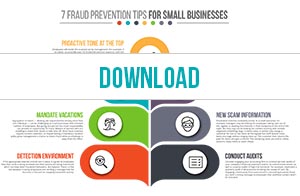 With careful planning and minimal investment, your small business can improve its ability to detect and deter fraud. Here are seven steps to consider:
1. Set a consistent, proactive tone at the top
Employees will model the example set by management. For example, if an owner occasionally pays for incidental personal expenses with the company’s petty cash, employees may view such behavior as permission to do the same.
2. Perform due diligence on new hires
In today’s tight market, your HR department may be eager to fill new positions. But you can’t afford to sidestep screening procedures, including calling references, checking educational credentials and conducting formal background checks on candidates who will have access to accounting systems, employee and customer data, cash and other valuable assets.
3. Mandate vacations
Segregation of duties — dividing job responsibilities among more than one individual — can be challenging at small businesses with a limited number of employees. But giving one person too much responsibility can provide an opportunity for fraud. Beware of workers who are unwilling to share their duties or take time off. Most fraud schemes require constant attention, so implementing a mandatory vacation policy gives management a chance to detect fraud while an employee is away from the office.
4. Create a perception of detection
If the appropriate internal controls are in place, it signals to employees that their work is being reviewed and their actions are being monitored, which can help deter fraudulent behaviors. But beware: There’s a fine line between trusting employees and sending a message that the business is focused on stopping fraudulent activity.
5. Educate employees
Some frauds are perpetrated by people outside of your organization. For example, retail businesses experience shoplifting, and banks deal with check fraud. These crimes differ from internal theft committed by employees. Consider training all employees, regardless of their functions, to recognize the warnings signs of internal and external fraud. The training should also provide information about how workers can report suspicious behavior, including collusion and conflicts of interest between coworkers and external stakeholders.
6. Stay on top of recent scams
Fraudulent schemes constantly evolve. In a retail operation, for example, managers may be looking for employees taking cash out of the register or stealing merchandise in their backpacks at the end of the night. But they may not be looking for cashiers working with outside organized shoplifting rings. In these cases, a cashier may charge a customer for one or two items at the register but stuff several more items into bags without ringing them up. The customer then returns the paid-for items and gets a refund. The remaining items are sold at online auctions, swap meets or pawn shops.
7. Conduct external audits
Consider engaging your accounting firm to conduct periodic audits of your company’s financial statement and/or its control environment, as well as surprise audits of high-risk functions. For example, implement a quarterly audit of all processes involving the receipt of cash. By engaging a third-party firm experienced in uncovering business fraud, you send a strong message to employees that unethical conduct won’t be tolerated.
These are just some of the steps you can take to help prevent losses. No matter how overwhelmed your business is during the pandemic, don’t be shortsighted by ignoring fraud prevention and detection. In the event that illegal behavior is discovered, you can quickly resolve the issue and mitigate the losses. An ounce of prevention can be worth a pound of cure.