
Q&A: Utilizing GRATs for High-Growth Assets
Using Grantor Retained Annuity Trusts (GRATs) to Transfer High-Growth Assets with Zero Gift Tax
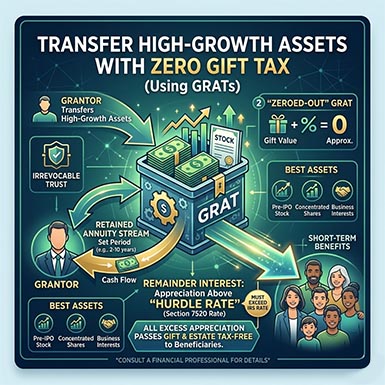
A Grantor Retained Annuity Trust (GRAT) is a powerful, yet complex, estate planning strategy that allows the grantor to transfer high-growth assets to beneficiaries with minimal or even zero gift tax liability by retaining the right to an annuity stream for a set period. The core of a successful GRAT hinges on the transferred assets’ investment return exceeding the IRS-published interest rate, known as the Section 7520 rate or “hurdle rate.” Any appreciation above this rate passes to the beneficiaries completely free of gift or estate tax.
Key Takeaways
What is a Grantor Retained Annuity Trust and how does it reduce taxes?
A Grantor Retained Annuity Trust is an irrevocable trust where the grantor retains an annuity payment for a set term, allowing any asset growth that exceeds the hurdle rate to pass tax-free to the beneficiaries.
What does it mean to set up a “zeroed-out” GRAT?
A “zeroed-out” GRAT is structured so that the annuity payments retained by the grantor are nearly equal to the initial asset value, which minimizes the calculated taxable gift value to near zero.
What kind of assets work best inside a GRAT?
Assets that work best in a GRAT are illiquid or concentrated assets expected to undergo a significant valuation increase or a near-term liquidity event.
Q: In simple terms, how does a GRAT work?
A: A Grantor Retained Annuity Trust (GRAT) is an irrevocable trust where the grantor (the person funding the trust) transfers assets—such as business interests, appreciated stock, or other investments—into the trust. In return for this transfer, the grantor receives a fixed annuity payment back from the trust every year for a set number of years, known as the term. At the end of that term, whatever assets remain in the trust (the residual) go outright to the beneficiaries (typically children or grandchildren) without any further gift or estate tax.
Q: What is the primary financial goal of setting up a GRAT?
A: The goal is to leverage the asset’s growth rate. The IRS requires you to calculate the present value of the annuity payments the grantor will receive, which is subtracted from the asset’s initial value to determine the taxable gift value. The faster the transferred assets appreciate above the IRS hurdle rate (the Section 7520 rate), the larger the tax-free wealth transfer to the next generation, as this “excess” appreciation escapes transfer taxation entirely. If the asset underperforms the hurdle rate, the grantor simply gets the asset back, and no harm is done.
Q: What does it mean to create a “zeroed-out” GRAT?
A: A “zeroed-out” GRAT is one where the annuity payments the grantor retains are calculated to be nearly equal to the initial fair market value of the assets transferred into the trust. This aggressively reduces, or “zeros out,” the present value of the remainder interest that is ultimately gifted to the beneficiaries. By setting the annuity so high, the calculated taxable gift value is pushed down to near zero, thus utilizing minimal or none of the grantor’s lifetime gift tax exemption. This strategy makes the transaction highly tax-efficient, especially when using short-term GRATs, as it is essentially a tax-free bet on the assets outperforming the hurdle rate.
“If the assets appreciate faster than the hurdle rate, the excess growth passes tax-free to the beneficiaries at the end of the term.”
Q: Why are short-term GRATs, often two or three years, favored in practice?
A: Short-term GRATs are preferred because they mitigate mortality risk and transfer the assets to beneficiaries sooner. If the grantor dies before the term of the GRAT is complete, the tax benefits are usually lost, and the assets may be pulled back into the grantor’s taxable estate. By shortening the term to a couple of years, the risk of the grantor’s premature death is reduced. Additionally, the shorter term locks in the appreciation sooner, allowing the cycle of creating new, “zeroed-out” GRATs (often called a “rolling GRAT” strategy) to be repeated quickly, maximizing the potential for tax-free growth transfers.
Q: What types of assets are most effective to transfer into a GRAT?
A: GRATs are particularly effective for illiquid assets or highly concentrated assets that are expected to undergo a near-term liquidity event or a significant valuation increase. Common examples include pre-IPO stock, interests in a closely held business, private equity fund interests, or large blocks of publicly traded stock expected to rally. The goal is to transfer the asset just before its value skyrockets, locking the low taxable gift value while all future growth passes tax-free.
Q: Does a GRAT provide any liquidity benefits for estate planning?
A: While the primary goal is transfer tax minimization, the GRAT structure helps manage liquidity because the annuity payments, which are cash flowing back to the grantor, can be used to cover the grantor’s income needs or fund other financial plans. Furthermore, for highly valuable, illiquid assets, the GRAT allows the grantor to effectively transfer the appreciation to the next generation without having to sell the underlying asset and incur immediate income tax consequences. This makes it an ideal structure for passing on significant wealth tied up in a family business or a single large investment.
Maximizing Wealth Transfer via Strategic GRAT Implementation
In summary, the Grantor Retained Annuity Trust (GRAT) remains a premier estate planning tool for individuals seeking to transfer significant appreciation to the next generation with minimal tax exposure. By leveraging “zeroed-out” structures and short-term “rolling” strategies, grantors can effectively capture the upside of high-growth or pre-liquidity assets—such as private equity or concentrated stock—while ensuring that the initial principal returns to them through an annuity stream. As long as the assets outperform the IRS Section 7520 hurdle rate, the excess value passes to beneficiaries entirely gift-tax-free, making the GRAT an ideal mechanism for preserving family wealth against the erosion of federal transfer taxes.
Disclaimer: This article provides general information and should not be considered professional financial or tax advice. Please consult with a qualified CPA or financial advisor for guidance specific to your individual business needs.
Questions?
Estate, Trust, and Succession Planning Services
Mark’s background in tax enables him to provide extensive services to the firm’s clients in the areas of estate and retirement planning, and business succession consulting.