
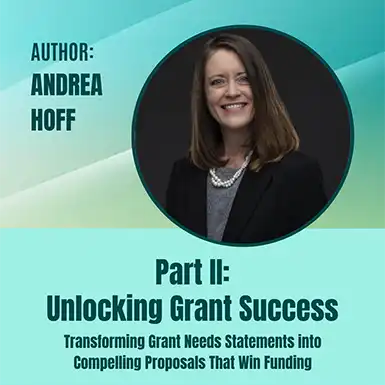
Unlocking Grant Success with Andrea Hoff
Transforming Grant Needs Statements into Compelling Proposals That Win Funding
A well-crafted grant needs statement sets the foundation for your entire proposal by establishing the essential narrative context for your project. It directly connects your community’s urgent problem to your proposed solution, budget requests, and evaluation plans. Funders use this critical anchor to evaluate whether your organization truly understands root causes and offers a viable solution.
Key Takeaways
- Lead with narrative over numbers: Effective needs statements establish a clear human story first and use targeted, credible data solely to support that context rather than overwhelming reviewers with statistics.
- Focus on community solutions: Grant makers fund community outcomes rather than internal organizational requests, making it essential to ground your proposal in the specific needs of the population you serve.
- Align the entire proposal: A well-crafted needs statement serves as the narrative anchor that directly justifies your project’s budget items, evaluation methods, and overall strategic plan.
Register today for Brady Ware’s Take Five Nonprofit Conference on October 27!
The Foundational Anchor of Your Proposal
A strong needs statement sets the stage for every single section in your proposal. It gives reviewers the critical answer to why your project matters. Why is your specific solution better than anyone else’s? Why do you need every line item in your budget? How does your evaluation plan tie back to addressing the core issue?
Without a clear narrative anchor, your entire application falls apart. When you build a cohesive case upfront, your budget requests and success metrics make total sense to reviewers. You are establishing the core rationale for your whole project.
Putting Human Faces Behind Hard Numbers
Data is just a collection of cold numbers until you reveal the real people behind them. To create a compelling grant application narrative, you must move beyond simply throwing raw statistics at reviewers. You need a clear framework that transforms scattered figures into a moving story about your community.
Visual clarity creates a strong emotional response in the reviewer’s mind. They need to feel that your work is too important to pass up. Focus on telling your human story first. Then, select specific data to substantiate that reality. This approach paints a clear picture of real-life impact.
“Numbers alone do not win grants; using those numbers to build a moving, cohesive case for your community is what truly resonates with reviewers.”
Avoiding Endless Data Rabbit Holes
Stretched-thin teams often assume they need dozens of statistics to prove a point. In reality, drowning reviewers in endless metrics only muddies your argument. You do not need 58 different data sources to make an impact. You just need credible data for grant proposals.
Stop wasting valuable hours chasing down obscure metrics. Identify which sources directly support your core narrative and cut the rest. Prioritizing quality over quantity saves precious staff time. It keeps your grant writers focused on clear arguments instead of getting lost in data rabbit holes.
Refreshing Stale Grant Writing Strategies
Even veteran writers fall into repetitive patterns over time. Taking a step back helps you challenge old assumptions and spot hidden weak points. Many experienced professionals miss easy points on scoring rubrics simply because their approach has grown stale.
Re-evaluating your process brings fresh energy to familiar proposals. Small tweaks to your structure can drastically increase grant proposal win rates. You move from just filling out forms to crafting persuasive arguments that grab a reviewer’s attention immediately.
Shifting from Data Dumps to Compelling Stories
The ultimate transformation happens when you shift your mental paradigm. Stop saying, “We have a problem, and here is the data.” Instead, say, “Here is why this problem matters, and here is our solution.”
One approach bores reviewers with endless facts. The other engages them instantly. There are real human lives behind every single statistic you cite. When you transition from researcher to storyteller, reviewers understand the true stakes. That narrative shift turns ordinary applications into winning proposals.
The Art of Narrative Grant Writing
At the end of the day, the biggest “aha” moment for grant writers comes down to making that crucial shift from researcher to storyteller. It is one of my absolute favorite light-bulb moments to watch happen, because so many writers gather data first and forget that grant applications are ultimately about telling a compelling human story. Numbers alone do not win grants; using those numbers to build a moving, cohesive case for your community is what truly resonates with reviewers. If you are ready to make that shift and transform your proposal strategy, join me at Brady Ware’s Take Five Nonprofit Conference on October 27, where we will dive deep into these exact frameworks so you can start winning more grants.
Brady Ware Nonprofit Advisors want to help you fulfill your mission with financial health and compliance services and a network of nonprofit consultants who specialize in strategic decision-making.
Register today for Brady Ware’s Take Five Nonprofit Conference on October 27!

Joel Kessel
Owner & President
You Thrive Training & Consulting
About the Author
Andrea Hoff, MPA, GPC, OCPC, ICPS provides training and consulting services in the areas of behavioral health prevention, nonprofit leadership, and grant writing. She is a certified grants professional (GPC) with extensive experience in grant writing. Andrea has worked in the behavioral health field for over 30 years, is certified in Ohio as a behavioral health prevention consultant (OCPC) and international behavioral health prevention specialist (ICPS). She is a certified QPR Suicide Prevention Gatekeeper Instructor and Substance Abuse Prevention Skills Training (SAPST) Instructor and uses Gallup CliftonStrengths assessments in her coaching work.
For more information, visit You Thrive Training & Consulting.