
Taking Your Nonprofit Board from Good to Great
Four Practical Steps That Can Take Your Nonprofit Board to the Next Level
At the Spring 2023 Take Five Nonprofit Leadership Conference, Cindy Cheatham helped nonprofit boards in her workshop Moving from Good to Great: Practical Steps toward an Engaged and High-Performing Board. Cindy sat down with us to answer a few questions about her workshop.
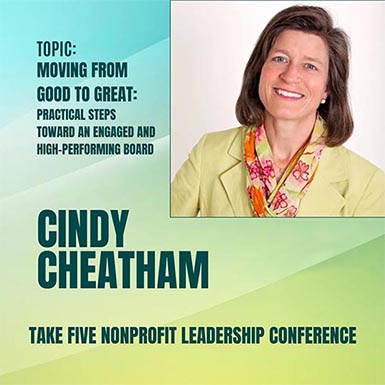
Tell us about your topic, “Taking your board from Good to Great.”
I’m going to explore how to improve your board with four practical steps. My approach applies to all types of boards by addressing a general framework for how to look at your board and the team working within your nonprofit through a full cycle: from what kind of board do you need at this point in your organization’s lifecycle, to how to focus, structure, recruit, onboard, support, and evaluate.
The role of a board can be complex, and most board members have little experience with comprehensive board development. It can seem overwhelming, but the primary need is to be intentional about your board’s strategy and operations. I will walk you through the overall purpose and role of a board. And I’ll share four practical steps that can help you take your good, okay, or even relatively weak board to the next level by understanding board development and its best practices.
How can you help nonprofit organizations and their boards?
As much as we love our nonprofit executive directors and CEOs, a nonprofit board is essential to the trust, credibility, and success and sustainability of a nonprofit. As a governance expert and fellow active nonprofit board leader, I want to show you how to help your board be a better asset for your organization. And hopefully I will motivate and equip your board to work successfully on the board’s growth and development.
I also want to motivate individual nonprofit leaders and board officers to be better leaders. I’ll introduce a framework that you could bring, even if you’re not an officer or not in charge of the governance. When my clients see this content, they’re inspired to go back and bring it to their team to say:
- Do we have clear board goals?
- How could we go to the next level?
- How could we get better organized to have more impact?
This workshop is an opportunity to bring in an objective process to your organization to improve yourself, improve your board, and improve your nonprofit overall.
Ultimately, the best nonprofits have strong boards. Foundations will tell nonprofit leaders, “We love your mission, but when we’re evaluating where to put our money, we look seriously at the strength of your board.” Having a strong board is an important aspect of nonprofit success, and it is a serious responsibility.
What sorts of challenges or problems could this topic help my board solve?
Nonprofit boards face common obstacles: some of these include time, complexity, lack of intentionality, and lack of process. Even if you recognize the symptoms, it can be difficult to enact change if you don’t understand what the obstacles are.
To break down barriers to understanding, questions you could ask yourselves include:
- How does the board’s role break down to make it feel less undefined or overwhelming?
- How can we identify a focus for the board for what the organization and board needs currently?
When thinking about the three hats of boards (Governance, Strategy, and Doing), sometimes boards don’t know where to start, and sometimes they get stifled and stuck. Best practices come into play when figuring out how to better engage your board for impact.
Ask yourselves:
- Do you have a plan and focus for your board?
- Does that plan and focus tie into a strategic plan or focus of your organization?
What is the most common obstacle that holds a board back from being great?
I think the most important obstacle is lack of intentionality. Boards need to take the time to come together and ask the same questions organizations ask themselves. Even the best board should evaluate itself every 1 – 2 years to gain focus as a team.
I challenge boards to ask themselves:
- Who are we now as a board?
- Where are we? What are the key issues?
- Where are we going?
- What type of board do we need to be now for this organization?
Another piece of intentionality is recognizing your board’s engagement and reasons for lack of leadership or engagement besides the reality that board members have busy lives. You will always have individuals more engaged than others, but if you want to improve that area, you need to be intentional with your board development; and you may need to be very strategic in recruiting for your gaps not just in skill but with willingness to lead.
Strategy 101 is being intentional without overcooking it. Don’t make it overly complex. This is what the four practical steps will help lay out to move you to a Better Board.
Brady Ware Nonprofit Advisors want to help you fulfill your mission with financial health and compliance services and a network of nonprofit consultants who specialize in strategic decision-making.
Spring 2023 Take Five Nonprofit Leadership Conference Video
Nonprofit employee recruitment and retention, disengaged board, how to leverage artificial intelligence, burnout, fear, increased salaries, low self-confidence, only begin to scratch the surface of the many challenges and complexities facing nonprofit leaders today. Fundamentally, nonprofit leadership isn’t a reward, it’s a responsibility. And if you agree with the statement above, consider some of these questions:
- Do you believe you are the right person to lead your organization?
- Do you want to be the person leading your organization?
- What does your organization require of you as its Executive Director or CEO today, and moving forward?
About Cindy Cheatham
Good Advisors LLC, is an independent management consulting organization led by Cindy Cheatham focused on strategic and business planning, board development, and organizational development for a diverse range of national, regional and local nonprofits and social-impact minded businesses. Ms. Cheatham is also a leadership coach for corporate and nonprofit leaders. Ms. Cheatham is very passionate about her work, always seeking to advance the impact of the clients she serves both during and after her engagements.
Prior to Good Advisors, Ms. Cheatham served as the VP of Consulting for the Georgia Center for Nonprofits where she led and oversaw work with foundations and hundreds of nonprofits. She also served as Venture Catalyst at Georgia Tech’s ATDC where she advised entrepreneurs and worked to build the entrepreneurial ecosystem. Ms. Cheatham began her consulting career with leading management consultancy Bain & Company. Ms. Cheatham is a frequent speaker on topics including leadership and succession, strategic and business planning, governance, collaborations and partnerships, nonprofit business models, social enterprise and entrepreneurship. She has developed and facilitated award-winning leadership programs.
Ms. Cheatham is active in the community where she serves as an elder of North Avenue Presbyterian Church and as former stewardship chair and current member of the Transition Committee. She serves on the board of two education-related nonprofits following a long history of engaging as a leader in a variety of roles within Dekalb County Schools. Ms. Cheatham is a 2010 fellow of the Georgia Partnership for Excellence in Education (GPEE) Policy Fellowship Program. And she is a Leadership Atlanta alumni.
She is a University of North Carolina at Chapel Hill Tarheel Honors Graduate and an MBA with distinction from Harvard Business School.
Cindy Cheatham
President & Senior Consultant
Good Advisors