
Q&A: Protecting Vital Roles in Succession Planning
Contingency Planning for Key Personnel: Beyond the CEO
Ensuring business continuity means extending succession planning beyond the CEO to include all critical roles whose sudden absence would significantly disrupt operations. Proactive contingency planning involves identifying these vital positions, developing specific backup plans and training programs for each, cross-training employees, and thoroughly documenting essential processes. Establishing a clear chain of command for interim leadership and regularly reviewing these plans are crucial steps to safeguard against unexpected departures and maintain operational stability.
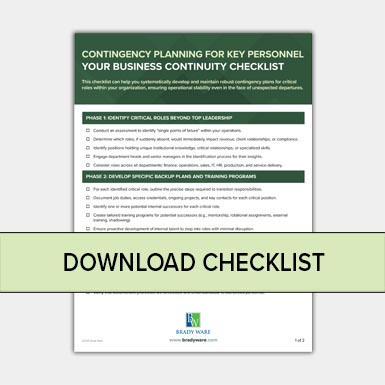
Q: How do we identify critical roles beyond the CEO?
A: Identifying critical roles goes beyond simply looking at the organizational chart. While the CEO is undoubtedly crucial, many other positions hold unique institutional knowledge, critical relationships, or specialized skills that are indispensable for daily operations. To identify these roles, consider asking:
- Who are the “single points of failure” in our processes? If this person were suddenly gone, what wouldn’t get done?
- Whose absence would immediately impact revenue, client relationships, or compliance?
- Which roles hold proprietary knowledge or expertise that is not easily replicated?
- Who manages essential vendor relationships or complex technical systems?
This assessment should involve department heads and senior managers, as they have the best insight into the interdependencies of their teams. Think broadly across finance, operations, sales, IT, human resources, and even specialized roles in production or service delivery. For instance, a lead engineer, the head of sales, the chief financial officer, or even a long-tenured office manager might be a critical link.
Q: What does “specific backup plans and training programs” entail for these key positions?
A: Once critical roles are identified, the next step is to develop actionable backup plans and dedicated training. A backup plan isn’t just naming a successor; it involves outlining the precise steps required to transition responsibilities. This includes documenting job duties, access credentials, ongoing projects, and key contacts.
For each critical role, identify one or more potential internal successors who possess a portion of the necessary skills or who have demonstrated high potential. Then, create tailored training programs. This might involve:
- Mentorship: Pairing the potential successor with the incumbent to transfer knowledge directly.
- Rotational Assignments: Allowing the potential successor to temporarily step into related roles to gain broader experience.
- External Training: Enrolling them in courses, certifications, or workshops to develop specific technical or leadership skills.
- Shadowing: Having the potential successor observe the incumbent in their daily tasks and decision-making.
“Ensuring business continuity means extending succession planning beyond the CEO to include all critical roles whose sudden absence would significantly disrupt operations.”
Q: How does cross-training and process documentation contribute to continuity?
A: Cross-training and thorough process documentation are foundational elements of contingency planning. Cross-training involves teaching employees in different roles how to perform aspects of each other’s jobs. This doesn’t mean everyone needs to be fully proficient in every role, but rather that multiple individuals understand the core functions and can step in during short-term absences or emergencies. For example, having two members of the accounting team understand core payroll processes, even if only one normally handles it, provides a vital safety net.
Documentation of essential processes means capturing the “how-to” of critical tasks, systems, and procedures. This includes step-by-step guides for software operations, client onboarding, vendor management, specific technical processes, and compliance requirements. This creates a living knowledge base that isn’t solely dependent on one individual’s memory. If a key person leaves unexpectedly, the documented processes ensure that anyone with appropriate authorization can follow the steps to keep operations running. This reduces the learning curve for replacements and minimizes the risk of errors.
Q: What is the importance of establishing a clear chain of command for interim leadership?
A: A clear chain of command for interim leadership is paramount to avoid confusion, paralysis, or conflicting directives during an unexpected absence. When a key leader departs suddenly, decisions still need to be made quickly and effectively. Establishing who is next in line to take over specific responsibilities ensures that there is no power vacuum or hesitation.
This involves:
- Defining interim roles: Clearly stating who steps into which role(s) in an emergency.
- Delegating authority: Specifying the level of decision-making authority the interim leader possesses.
- Communication protocols: How will the interim leadership communicate internally and externally?
This might be a tiered approach, where a department head steps up if their direct report is absent, or a designated senior leader takes on broader responsibilities if an executive is unavailable. Pre-defining these pathways removes uncertainty and allows the business to react swiftly and decisively, maintaining stability and confidence among employees and stakeholders.
Q: How often should contingency plans be reviewed and updated?
A: Contingency plans are not “set it and forget it” documents; they are dynamic and require regular review and updates. Businesses are constantly evolving: personnel change, new technologies are adopted, processes are refined, and market conditions shift. A contingency plan that isn’t updated can quickly become obsolete and ineffective.
A good practice is to review these plans at least annually, or more frequently if there are significant organizational changes (e.g., major hires, departures, mergers, new product launches, or shifts in strategy). Key triggers for review should include:
- Changes in personnel: Especially if a critical role incumbent or a designated successor leaves.
- Changes in technology or systems: New software, cloud providers, or operational tools may alter critical processes.
- Significant business growth or restructuring: New departments, expanded services, or a revised organizational chart.
- Regulatory changes: New compliance requirements might affect critical roles or processes.
Regular reviews ensure that the plans remain relevant, accurate, and actionable, providing true peace of mind that your business is prepared for the unexpected.
Fortifying the Future Through Holistic Succession
Ultimately, the goal of robust succession planning extends far beyond the traditional focus on the CEO; it is about establishing true business resilience. By taking a holistic approach—meticulously identifying all single points of failure, developing specific talent through mentorship and cross-training , and documenting essential processes—an organization transforms key personnel into a strategic asset rather than a hidden liability. A clear chain of command and a commitment to regular review ensure that these contingency plans remain dynamic and actionable. Protecting vital roles is not merely a human resources exercise; it is an essential investment in stability, continuity, and the sustained confidence of customers, employees, and stakeholders. A company that systematically prepares for the unexpected departure of any critical player is a company built to endure and thrive.
Disclaimer: This article provides general information and should not be considered professional financial or tax advice. Please consult with a qualified CPA or financial advisor for guidance specific to your individual business needs.
Questions?
Cody has been guiding closely held businesses across diverse industries since joining the firm in 2016. His expertise spans individual and corporate taxation, long-term business planning, and seamless succession and exit strategies.