
Leading with Curiosity for Nonprofit Growth
How Nonprofit Leaders Can Use the Courage and Curiosity Framework to Reduce Burnout and Empower Staff
Many of the nonprofit leaders I work with are trading the pressure of “having all the answers” for a curiosity-based leadership approach because it helps reduce burnout and increase ownership among their team. By shifting from a “fixer” mindset to one focused on open-ended questions and vulnerability, executive directors can get rid of the “having to have all the answers” myth that often leads to anxiety, burnout, and paralysis. This transition allows leaders to focus on the bigger picture of strategic growth rather than getting bogged down in every minor fire that pops up any given day, ultimately creating a more resilient and empowered culture.
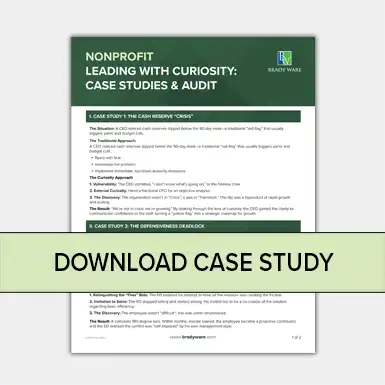
Breaking the Anxiety
Some leaders in the nonprofit sector struggle with confidence. They face high levels of stress and “paralysis” driven by an internal belief that they must be the smartest person in the room. This self-imposed pressure creates an environment where leaders feel they must solve every problem for their boards and staff, leading to a state of constant overwhelm. When a leader believes they must provide the final word on everything from financial dips to volunteer management, they inadvertently create a bottleneck that slows down mission-critical work. This weight makes them feel like they are all alone on an “island,” and oftentimes unintentionally puts up a barrier to the very success they are trying to achieve.
Escaping the Isolation of the “Island” Effect
Assuming the role of the sole problem-solver doesn’t just exhaust the leader; it fundamentally isolates them. This “island” effect prevents executive directors from leveraging the collective intelligence and diverse perspectives of their surrounding teams. When a leader acts as the “fixer,” they send a message to their staff that their input is secondary. However, by implementing a curiosity mindset, executives can further connect with their teams. Instead of carrying the burden alone, curious leaders lean into vulnerability, admitting when they don’t have “all the answers” and invite their team to help find the solution. This “We over Me” approach, consistently put into practice over time, can transform a team and organization.
Navigating Uncertainty with a Decision-Making Framework
To manage the chaos and to be more effective, consider following a decision-making framework designed to help you gain more clarity faster, and reduce the burnout and overwhelm that oftentimes comes with the chaos. The framework helps categorize a challenge or situation into one of three buckets: Control, Influence, or Concern. Most leaders waste an enormous amount of emotional energy in the “Concern” bucket—worrying about national recessions or legislative decisions they cannot change. By refocusing on what they can control or directly influence, leaders can be effective in their work.
“We can’t plan our way out of a situation; we have to act our way out. When a leader trades the pressure of having all the answers for the power of a curious question, they stop being a bottleneck and start being a catalyst.”
Empowering Through Curiosity
When a leader stops trying to be the fixer, it can turn into a boost in staff morale and creative problem-solving. Instead of providing the answer or immediate solution, ask open-ended questions—such as “What is at stake if we don’t act?” or “What would it look like if this were easy?”—to challenge thinking, increase ownership, empowerment and accountability, and influence a staff member’s growth. This approach may take courage through curious action, as it involves trusting that the staff is capable of handling the responsibility. By stepping out of the way, leaders allow their volunteer coordinators, development directors, and program managers to take true ownership of their roles, resulting in an organization that is far more than the sum of its parts.
Quick Tips for Starting Today
- Show Up Blank: Enter your next meeting without a pre-set solution in mind.
- The “Yes, And” Rule: Use this technique to validate staff ideas before building on them.
- The 90-Day Rule: Ask if a problem is a permanent crisis or a temporary transition.
- Categorize Your Day: Sort your to-do list into Control, Influence, and Concern.
- Invite the Growth: Ask a defensive team member to help design the solution rather than fixing it for them. Be curious.
- Pause Before Fixing: When a staff member brings a problem to your attention, ask “What have you considered so far?” before offering advice.
The Path Forward: From Fixing to Leading
Ultimately, the transition from a “fixer” to a curious leader is a journey from exhaustion to effectiveness. By dismantling the myth of the all-knowing executive and embracing the vulnerability required to ask rather than tell, nonprofit leaders can remove the barriers of isolation that hinder their growth and the influence they have on their people. Adopting the Courage and Curiosity framework—focusing on the Control-Influence-Concern model and inviting staff into the problem-solving process—does more than just lower stress levels; it builds a culture of ownership, empowerment and accountability. When you replace the need for certainty with the power of a well-timed question, you stop being a bottleneck and start being a catalyst for a more resilient, mission-driven team.
Brady Ware Nonprofit Advisors want to help you fulfill your mission with financial health and compliance services and a network of nonprofit consultants who specialize in strategic decision-making.

Joel Kessel
Executive Coach
Kessel Strategies
About the Author
Joel Kessel is an executive coach and strategic advisor who helps nonprofits increase their impact through peer group executive sessions and one-one coaching, board and team retreats, and leadership development. Joel has spent his entire 25+ year career deeply connected to the nonprofit community. He has worked inside and advocated on behalf of nationally recognized organizations including the National Multiple Sclerosis Society, Ronald McDonald House Charities, AirLifeLine, and the National Runaway Safeline, as well as numerous Ohio-based organizations including the Charitable Healthcare Network, Habitat for Humanity, Van Wert Performing Arts Foundation, and the Center for Disability Empowerment.
For more information, visit Kessel Strategies.