
Address Digital Assets in Your Estate Plan
Digital Assets: Essential for Your Estate Plan
These days, digital assets are ubiquitous, some of which can be high in value. It’s essential that your estate plan properly accounts for intangible digital assets. Otherwise, your heirs may not be able to access them.
What the States Say
Most states have laws that allow an individual’s family or executor the right to access and manage digital assets after the owner dies. The Uniform Law Commission created the Revised Uniform Fiduciary Access to Digital Assets Act of 2015, with the goal of allowing “executors, trustees, or the person appointed by the court complete access to deceased’s digital assets.”
However, many U.S. accounts fall under the “terms of service” or “privacy policy” of the digital platform. These platforms, such as Twitter, Facebook, or Gmail, have ambiguous policies about what happens to your accounts after your death. So, it’s important to incorporate digital assets into your estate plan as soon as possible.
What Are Digital Assets?
Because people routinely conduct financial transactions online, it’s common for individuals to store financial records in their smart phones, computer hard drive, on in the cloud. These and other digital assets can include:
- Cryptocurrencies, such as Bitcoin, Dogecoin, Ethereum or Tether,
- Non-fungible tokens (NFTs), such as digital art or music, that are blockchain protected and assigned values,
- Website domain names,
- Social media accounts,
- Digital photographs and videos,
- Digital rights to musical, literary, motion picture or theatrical works,
- Online gambling accounts,
- Blog content, and
- Monetized video channels that generate advertising revenue.
A digital asset is typically anything created and stored digitally that 1) is identifiable and discoverable, and 2) holds or offers value. To be considered an asset, it must have the potential to create value for the owner. As a result, you can transfer ownership through a purchase, a gift, or other ways of transferring rights along with its value.
What Are the Hurdles to Digital Access?
Legally, digital property is handled like other types of property when it can be passed on to specific people or entities through estate plans. Laws regarding digital assets are still evolving, and consequently, it can be challenging for anyone other than the original owner to gain access to digital assets and digitally encoded financial data.
Several hurdles are commonly faced by family members when they attempt to access a deceased family member’s digital assets and important personal data, including:
Passwords
If heirs don’t know your passwords, decryption keys or other access credentials, they may be unable to access digital assets, information or property. When passwords are stored on a laptop or tablet, technology experts typically can bypass the passwords. But some accounts, such as iPhones, may be difficult or almost impossible to access without the passwords. Cryptocurrencies and NFTs are typically stored in a “crypto wallet.” If the password and private key to a crypto or digital wallet are lost, access may be lost forever because those platforms have no administrator.
Data encryption
While encrypted digital data provides an additional layer of security, it can also make it nearly impossible to access without the password or encryption key.
Criminal laws
State and federal laws ban unauthorized access to computer systems and private personal data. Designed to protect consumers from fraud and identity theft, they can present challenges for people attempting to gain access to a deceased family member’s digital information. Although this is an area that’s evolving as technology evolves, it remains complex.
Data privacy laws
Federal data privacy laws generally prevent digital service providers from disclosing the contents of electronic communications to anyone except the owner without the owner’s legal consent. This could allow social media sites or other internet providers to lock your content unless you give express permission for others to access it, which could be expensive to challenge in court.
How to Handle Digital Assets in Your Estate Plan
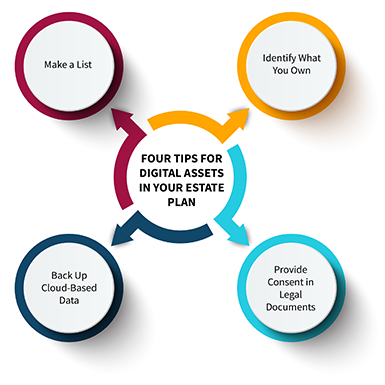
Fortunately, it’s relatively easy to address the hurdles around digital assets in your estate plan. Here are four tips for arranging full access to your digital assets, minimizing administrative costs, and guaranteeing no significant or valuable digital property is lost.
1. Make a list.
A record of digital assets can help your heirs know which assets you own and where they’re located. Include all important passwords, online accounts (such as email and social media) and digital property (such as domain names, cryptocurrency and money transfer applications). Keep the list in a safe location (for example, with your estate planner) and make sure family members or relevant heirs understand how to access it.
Non-cryptocurrency digital assets are generally safe with inexpensive password management apps. In terms of keys and passwords for cryptocurrencies and NFTs, avoid storing them digitally. Legally, if hackers break into a bank or brokerage account, the institution usually has insurance or protection. If hackers break into a crypto wallet, you’re out of luck. Be particularly cautious about where you store your cryptocurrency passwords and keys.
2. Identify what you own.
In some cases, you might have thought you acquired a digital asset, but you only purchased a nontransferable license to use it. This often applies to software, music and videos. Understand the terms of agreement for music files or other digital assets to determine if you own — or have only licensed — them.
3. Back up cloud-based data.
Cloud providers often have backups. But what if the cloud service goes down or goes out of business? Providers, such as FidSafe, offer services that act as online digital safe deposit boxes to store digital backups of electronically scanned documents. Examples include bank and investment account statements, birth certificates, passwords, tax records, and wills. Of course, if you have digital assets stored in the cloud, you should back them up to a local computer or backup memory device regularly.
4. Provide consent in legal documents.
Your estate planning attorney can help you update your wills, powers of attorney and revocable living trusts. In addition, these documents should include language providing lawful consent for providers to turn over the contents of your digital communications to the proper individuals. Think through which information you want to be made available. You might not want all your digital assets accessible to your heirs.
Contact Us
Most people live connected to technology in their everyday lives, with emails, texts, photos stored in the cloud, and financial records that only exist as digital files. Consider appointing a special executor experienced in dealing with digital assets if you have a significant amount to ensure your assets are properly handled. Contact your financial and legal advisors to update your estate plan for the 21st century.
Estate, Trust, and Succession Planning Services
Mark’s background in tax enables him to provide extensive services to the firm’s clients in the areas of estate and retirement planning, and business succession consulting.